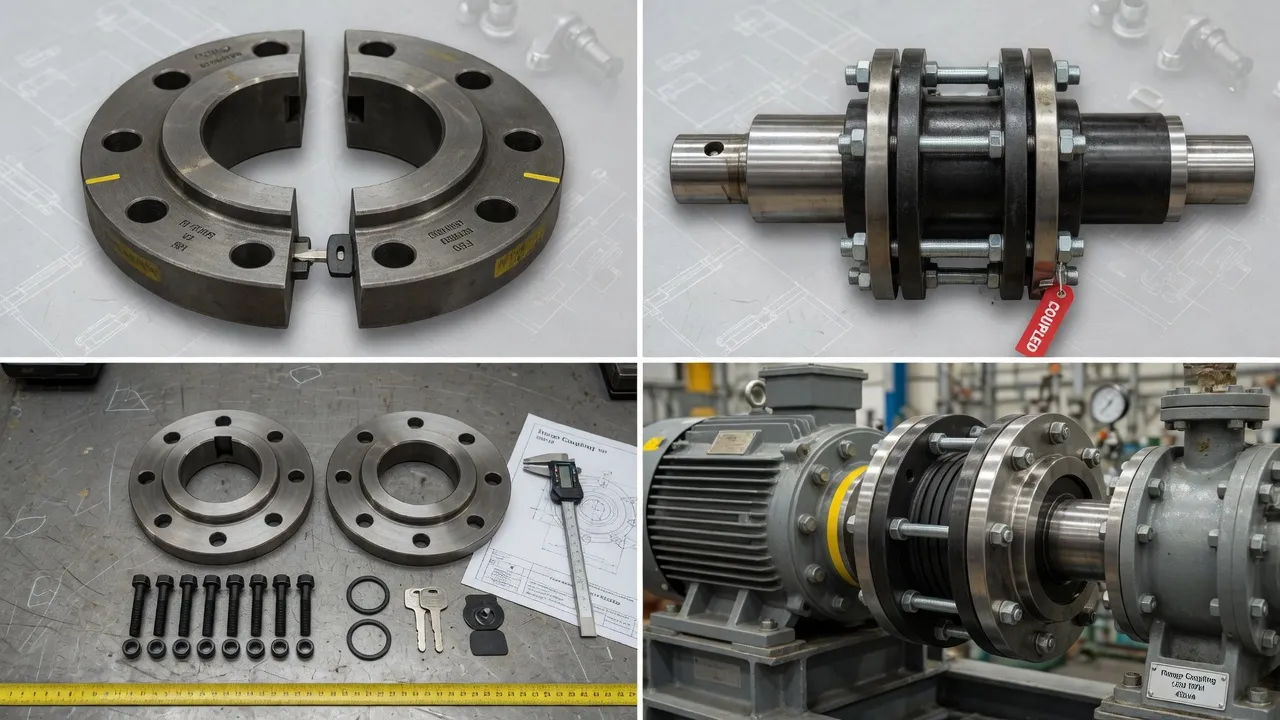
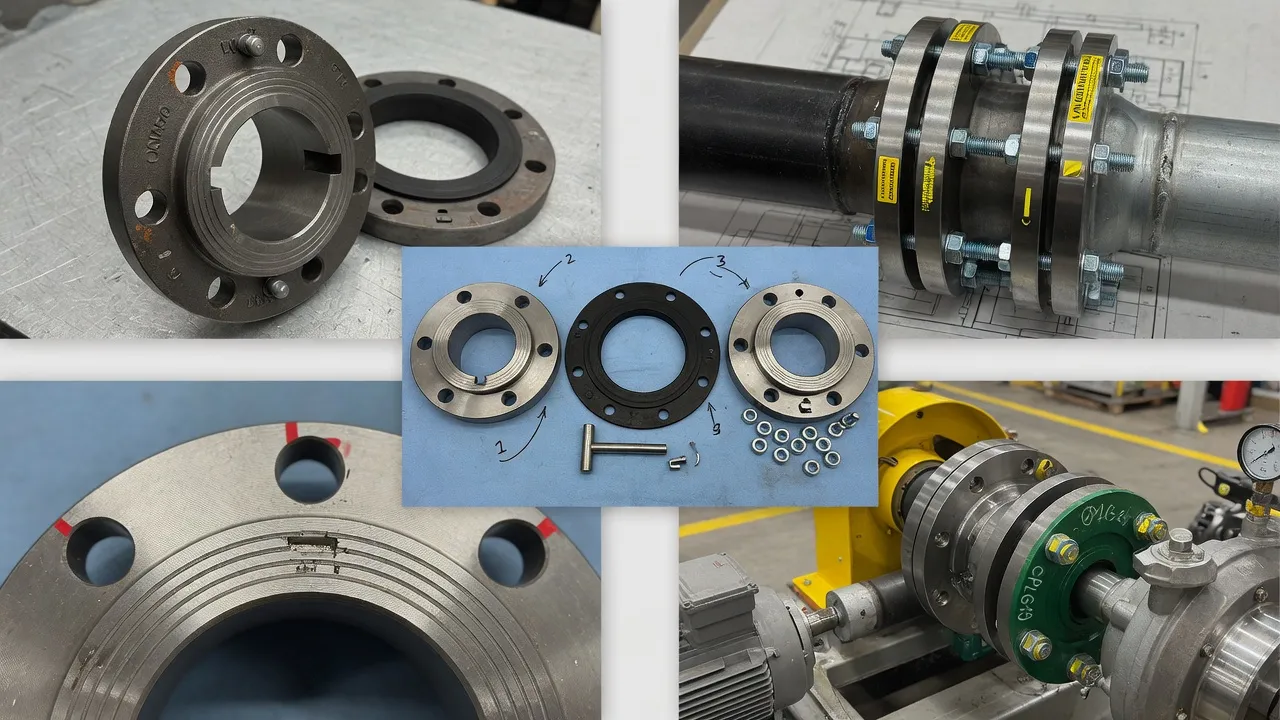
The distinction between solid (one-piece) and split (two-piece) coupling hub design is a maintenance engineering decision as much as a mechanical engineering one. Both designs can achieve the same torque ratings, bore ranges, and misalignment tolerances. What they differ in is how accessible the coupling is for maintenance — specifically, whether the coupling can be removed from the shaft without axial machine movement. In pump maintenance contexts, this distinction translates directly into the difference between a 6-hour seal replacement job that requires motor dismounting and a 45-minute seal replacement job that does not. The drop-out spacer coupling and the Fenaflex replacement spacer coupling designs represent the mainstream approach to rapid pump maintenance access in Australian industry, combining solid hub integrity with spacer-design maintenance efficiency.
Solid vs Split Hub — The Engineering and Maintenance Comparison
Criterion
Solid Hub Coupling
Split Hub Coupling
Hub structural integrity
Maximum — no discontinuity in hub cross-section
Slightly reduced — split plane is a structural discontinuity
Concentricity after reassembly
Not applicable — never disassembled during element change
Depends on split plane dowels and machining quality
Removal from shaft
Requires axial shaft movement — motor or pump must be moved
Radial removal — no shaft movement required
Element replacement time
2–8 hours (includes motor repositioning)
15–45 minutes (direct access without motor removal)
Standard Solid Coupling (Lowest Initial Cost, Highest Maintenance Cost)A standard solid hub coupling on a close-coupled pump requires full motor dismounting for every elastomeric element replacement or pump seal change. For pumps with infrequent maintenance requirements — annual or less frequent seal replacement — this is acceptable. For pumps with frequent seal replacements, this design accumulates labour costs rapidly that dwarf the coupling’s initial cost advantage.
2
Split Hub Coupling (Moderate Cost, Moderate Maintenance Improvement)A split hub coupling allows the hub halves to be removed radially without motor movement, giving direct access to the coupling element and limited access to the pump seal space behind the coupling. This design improves maintenance access significantly over a solid coupling but does not provide the full axial gap of a spacer coupling for seal cartridge extraction.
3
Drop-Out Spacer Coupling (Higher Initial Cost, Lowest Maintenance Cost)The spacer tube is removed radially without moving either hub, creating a gap between the motor and pump equal to the DBSE (typically 85–250 mm). The seal cartridge slides out through this gap, is replaced, and the spacer tube is refitted. Motor alignment is never disturbed. This design provides the maximum maintenance efficiency and is the standard specification for any pump experiencing more than one seal replacement per year.
Where Each Design Is the Standard Specification in Australia
Water Utilities — NSW and Victoria
Drop-out spacer coupling is the standard specification across major water utility pump stations. The combination of frequent seal replacement schedules and the need to minimise pump room downtime makes the spacer design the engineering default.
Process Industry — Chemical and Petrochemical
Split hub couplings are common in process plant where the chemical exposure and elevated temperatures make pump seal replacement more frequent than in clean water applications. The split hub provides access without full motor removal.
⛏️
Mining — Slurry Pump Installations
Slurry pumps require frequent liner and impeller replacement in addition to seal maintenance. Drop-out spacer couplings are specified to allow complete back-pull-out access without disturbing the motor and pump base alignment.
️
General Industrial — Standard Pumps
Standard solid hub flexible couplings are used on most general industrial pumps where seal replacement is infrequent or where motor removal is straightforward. The solid hub design remains the majority of the installed base in general industrial applications.
Frequently Asked Questions
Can a split coupling handle the same torque as a solid coupling?+
Yes. A correctly engineered split coupling — where the split plane is through the hub body and the two halves are clamped together by high-tensile bolts — can achieve the same torque rating as an equivalent solid coupling. The critical engineering requirement is that the clamping bolts across the split plane must develop sufficient preload to prevent the half-flanges from opening under the bending moment and centrifugal forces at the maximum operating speed. Split couplings for high-torque, high-speed applications use larger clamping bolts and tighter manufacturing tolerances at the split plane to maintain structural integrity.
What is the main advantage of a split coupling over a solid coupling?+
The primary advantage of a split coupling is that it can be removed from a shaft without axial movement of the shaft or the connected machine. A solid hub must be slid off the shaft axially — which requires the connected motor or pump to be moved, disconnecting piping, cables, and potentially disturbing alignment. A split coupling is unbolted and the two halves are removed radially, leaving both shafts in place. This is the maintenance efficiency gain that makes split couplings the preferred design for pump installations where frequent elastomeric element replacement is required.
Is a drop-out spacer coupling the same as a split coupling?+
A drop-out spacer coupling and a split coupling address the same fundamental maintenance problem — access for pump seal or impeller replacement — through different design approaches. A split coupling has hubs that separate into halves, allowing the coupling to be removed without shaft movement. A drop-out spacer coupling has a solid hub on each shaft and a spacer tube between them that can be removed radially (after unclamping) without moving either hub or shaft. In practice, the drop-out spacer design is more common in Australian water and process industry because it retains the original solid hubs (better concentricity and hub integrity) while still providing rapid seal access.
Do split couplings require any special installation or maintenance?+
Split couplings require that the split plane bolt torque be checked more frequently than a solid coupling’s flange bolts, because the split plane bolts are in a more complex stress state — they carry both the clamping preload and some of the bending moment at the split plane. The split plane mating surfaces must be clean and free of burrs before reassembly. Anti-seize on the split plane bolts prevents galling during repeated assembly and disassembly. Some split coupling designs include alignment dowels across the split plane that ensure the two halves re-register correctly on reassembly.
Which coupling design is more expensive — split or solid?+
Split couplings cost 20–50% more than equivalent solid couplings of the same rating, due to the more complex hub machining (split plane, cross-bore clamping bolts, split plane dowels) and the tighter manufacturing tolerances required at the split plane interface. However, this cost premium is typically recovered within the first maintenance event where the split design saves motor dismounting — a labour saving of 4–8 hours per event at AUD 85–120 per hour. For pump installations with annual seal replacement frequency, the split coupling’s cost premium is recovered in the first maintenance cycle and delivers ongoing savings thereafter.
Need Expert Coupling Advice?
Our engineering team in Condell Park NSW is ready to help — free of charge.