Finding the right replacement coupling for a piece of equipment is one of the most common and most frustrating tasks in plant maintenance. The original coupling may carry a part number that leads nowhere ¡ª a superseded design, a defunct manufacturer, or an OEM-specific code that was never publicly catalogued. Or the coupling may have no markings at all ¡ª worn smooth by years of service. In either case, the path to a correct replacement starts with a systematic approach to identifying what you have, and ends with a supplier who can cross-reference it to a stocked equivalent. This guide covers both ends of that process, including when to use Fenaflex replacement spacer couplings as a direct-fit solution and how to specify a cast iron or steel rigid coupling replacement to the correct bore and torque rating.
Step 1 ¡ª Identify What You Have
The first step in finding a replacement coupling is identifying the existing coupling type and size. If any markings are visible on the hub face, flange, or coupling guard ¡ª manufacturer name, part number, size code, or bore marking ¡ª record them photographically before any disassembly. A size code stamped into the hub (e.g. “F125”, “L099”, “GL-16B”) is often sufficient for an immediate cross-reference.
1
Check the Equipment DocumentationThe original equipment manufacturer (OEM) manual, maintenance record, or spare parts list often includes the coupling specification. Search for these documents in the equipment file, the OEM’s online spare parts portal, or in the machine’s electrical schematics (coupling specifications sometimes appear in motor and driven machine data sheets).
2
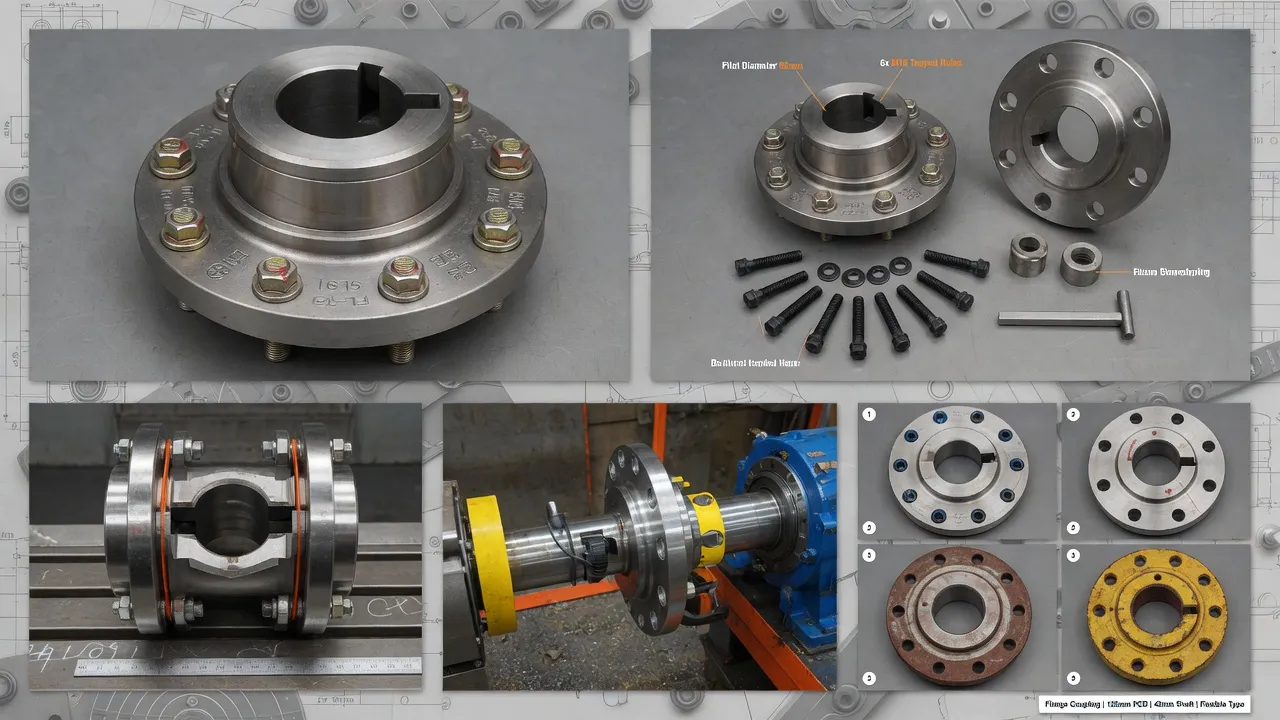
Measure the Coupling DimensionsIf documentation is unavailable, measure the coupling with the machine isolated. Key measurements: motor shaft diameter and keyway dimensions; driven machine shaft diameter and keyway dimensions; coupling outer diameter; bolt circle diameter (for rigid couplings); tyre or spider outer diameter (for flexible types); and axial length of the assembly (DBSE).
3
Photograph the CouplingBefore any disassembly, photograph the coupling from multiple angles with a ruler in frame. These photos allow expert identification from outside the plant ¡ª email them to [email protected] for a cross-reference if the coupling type is not immediately obvious from the dimensions.
Step 2 ¡ª Cross-Reference to a Current Equivalent
Most standard coupling types have been manufactured by multiple suppliers over many decades, and dimensional standards for the most common designs (jaw couplings, tyre couplings, rigid flange couplings) are widely shared across manufacturers. The following cross-reference guide covers the most common replacement scenarios in Australian maintenance:
Original Brand / Type
Ever Power Equivalent
Match Basis
Notes
Fenner Fenaflex F40¨CF250
EP-FF series (Fenaflex replacement)
Dimensional ¡ª OD, PCD, tyre seat, DBSE
Tyre element compatible with OEM hubs
Lovejoy L-series jaw coupling
EP jaw coupling (L-series)
Dimensional ¡ª jaw geometry, spider OD, bore range
Spider elements interchangeable
Rexnord Thomas disc coupling
EP disc coupling (DC series)
Torque, bore, disc pack bolt circle
Bolt pattern verification required
Flender / Bibby rigid flange
EP rigid flange (RFC series)
Bore, PCD, bolt count and diameter
Material grade match required for high torque
Voith fluid coupling
EP YOX series
Power range, shaft diameters, fill volume
Oil specification verification required
Dodge Para-Flex tyre coupling
EP F-type tyre coupling
Tyre OD, hub flange OD, bore range
Hub redesign may be needed
Step 3 ¡ª Verify the Torque Rating of the Replacement
Before ordering the replacement coupling, verify that its rated torque meets the design torque of the application ¡ª not just the nominal running torque. Calculate: T_nominal = 9,550 ¡Á kW ¡Â RPM, then multiply by the service factor for the application (1.25¨C4.0 depending on load character). The replacement coupling’s rated torque must exceed this design torque. If the original coupling was failing prematurely, consider whether the original may have been under-rated, and size the replacement with a higher torque margin.
Step 4 ¡ª Confirm Bore Availability and Delivery
Standard coupling sizes with pilot bores (un-machined) are typically available ex-stock. Finished-bore couplings (machined to your exact shaft diameter and keyway) require a short machining lead time ¡ª typically 2¨C5 business days for standard sizes. When placing an order for a finished bore coupling, specify: bore diameter to ¡À0.01 mm; keyway width and depth per ISO 773; key type (parallel or Woodruff); and any tolerance requirements beyond the standard H7 bore.
Frequently Asked Questions
How do I identify a coupling with no markings or part number?+
If the coupling has no visible markings, identify it by measuring: the hub outer diameter, the bore diameter, the hub length, the flange outer diameter, the bolt circle diameter (PCD), the number and diameter of bolt holes, and the overall coupling length (DBSE). For flexible tyre couplings, also measure the tyre outer diameter and tyre width. With these dimensions, cross-reference against manufacturer dimensional tables. Send the measurements to [email protected] ¡ª our team can identify the coupling type and equivalent from any major manufacturer in most cases.
Can I replace a coupling from one manufacturer with one from another?+
Yes, in the majority of cases. Most standard coupling designs (jaw/spider, tyre, disc, chain) have been widely produced by many manufacturers to similar dimensional standards, and cross-brand replacement is common. The critical dimensions to match are the bore sizes, the bolt circle diameter (for rigid and split-type couplings), the tyre or spider interface dimensions (for flexible types), and the DBSE if a spacer is involved. The torque rating of the replacement must meet or exceed the original. Contact our team with the original coupling details for a confirmed cross-reference.
What information do I need to give a coupling supplier for a replacement?+
The minimum information needed for a replacement coupling quotation: coupling type (jaw, tyre, rigid flange, chain, universal, etc.); bore diameter for each hub (motor side and driven side); shaft keyway dimensions if keyed; rated torque or motor power and speed; and the DBSE if a spacer coupling. Useful additional information: original manufacturer and part number if visible; coupling outer diameter if unusual space constraints apply; operating environment (temperature, chemicals, outdoor). With motor power, speed, and bore diameters alone, our team can identify the correct replacement in most standard pump and fan applications.
Does a replacement coupling need to be the same size as the original?+
The replacement coupling must have the same bore range to fit your shafts, and its torque rating must meet or exceed the design torque (nominal torque ¡Á service factor). If you are replacing a coupling that has been failing prematurely, the replacement may be intentionally specified one size larger to increase the torque margin. The physical size of the replacement (outer diameter, DBSE) must fit within the available space ¡ª check that the coupling guard can accommodate the replacement before ordering.
How quickly can I get a replacement coupling in Australia?+
For standard coupling types and sizes, Ever Power stocks a comprehensive range ex-warehouse at Condell Park NSW, with same-day or next-business-day despatch for most orders placed before 2 PM AEST. For non-standard bore sizes requiring machining, allow 2¨C5 business days. For specialised coupling types (marine grade, classification certified, custom DBSE spacers, non-standard elastomers), allow 5¨C10 business days. For exact availability on a specific coupling, contact [email protected] with the coupling details and required delivery date.
Need Expert Coupling Advice?
Our engineering team in Condell Park NSW is ready to help ¡ª free of charge.