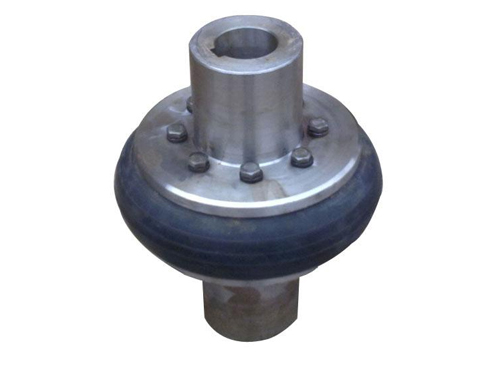
The fault characteristics and solutions of the sliding block coupling
Due to various reasons, the center of mass or inertial principal axis of the slider coupling does not coincide with the axis of rotation, and the phenomenon of unbalanced centrifugal inertial force, centrifugal inertial couple force and dynamic deflection (vibration shape) will occur during operation, which is called the phenomenon of rotor Unbalance phenomenon, this kind of unbalance phenomenon will inevitably cause the vibration of the shaft system, which will affect the normal operation and service life of the machine, so it should be taken seriously.The degree of unbalance (unbalance U) is usually expressed by the product mr of the mass m of the rotor and the distance r from the center of mass to the axis of rotation of the rotor, which is called the product of mass diameter.It is also expressed by the product of mass diameter per unit mass, called the eccentricity e (not geometrically eccentric.) The product of mass diameter mr is a relative quantity related to the mass of the rotor, while the eccentricity e is a value that has nothing to do with the mass of the rotor.的量。 The amount.The former is relatively intuitive, and is often used for specific balancing operations of a given rotor, while the latter is used to measure the pros and cons of the rotor balance or to check the balance accuracy. The balance grade standard of the coupling is evaluated by e.For a flexible rotor, use the mode eccentricity (the nth mode) en=Un/mn, and Un and mn are the nth mode and the mass of the first mode respectively.
When the lubrication effect of the coupling and the bearing bush fails to meet the requirements, a variety of failure characteristics will appear.If the oil pressure is low, the part between the shaft and the bearing bush will cause dry friction due to direct contact and cause damage and damage to the moving surface. At this time, the shaft surface is blue.If the lubricating oil fails or the pressure cannot be built up, the moving surface will lose the protection of the oil film and directly contact for dry friction.When the temperature rises, the alloy layer of the bearing bush melts, and the “shock” phenomenon will occur if the machine stops in time. Failure to stop the machine in time will cause more serious damage to the parts.
Certain types of bearings that are really hard to buy have no spare parts and have to be repaired after failure, especially bearings; bearings have minor damage, such as slight water rust during storage, and slight fretting abrasion during transportation. It is a pity that this kind of situation is easy to discard.In addition to economy, the repair of couplings is also technical, which requires the repairer to fully understand the corresponding technical requirements of the bearing, and the characteristics of the structure, process and material of the bearing and its parts. Otherwise, it is difficult to repair the bearing. There are satisfactory results.The main material factors that affect the service life of high-carbon chromium steel rolling bearing parts and the degree of control are: (1) The carbides in the original structure of the steel before quenching are required to be fine and dispersed.High temperature austenitization can be used at 630°C or 420°C, or it can be achieved by forging and rolling waste heat annealing process. (2) For GCr15 steel after quenching, it is required to obtain a microstructure of cryptocrystalline martensite with an average carbon content of about 0.55%, about 9% of Ar, and about 7% of undissolved carbides in a uniform and round state.