Description
The spacer coupling is the engineering answer to a single, universal problem in centrifugal pump and engine drives: how do you service the driven machine — replace a mechanical seal, withdraw the pump rotor, change a wear ring — without disturbing the carefully aligned motor sitting on its baseplate? By inserting a defined Distance Between Shaft Ends (DBSE) between two flexible elements, this industrial shaft coupling creates the working clearance that maintenance routines need, while still transmitting full rated torque and absorbing misalignment in both planes.
Spacer Coupling Specifications
The standard tyre-type spacer coupling range covers tyre sizes F40 through F250, with the most commonly specified DBSE values of 80, 100, 140 and 180 mm. Each tyre element accommodates 4 degrees of angular misalignment and 6 mm of parallel offset independently — so the assembled coupling absorbs the misalignment of two flex planes acting in series. Torque capacity scales from 10 N·m for the smallest pump auxiliary drive up to 20,000 N·m on heavy diesel engine connections.
| Tyre Size | Max Torque (N·m) | Max Speed (rpm) | Bore d (mm) | Std DBSE (mm) | Angular | Parallel |
|---|---|---|---|---|---|---|
| F40 | 10 | 4,800 | 12–20 | 80 / 100 | 4° | 6 mm |
| F50 | 20 | 4,500 | 14–25 | 80 / 100 | 4° | 6 mm |
| F60 | 40 | 4,000 | 16–30 | 80 / 100 | 4° | 6 mm |
| F70 | 70 | 3,800 | 18–34 | 80 / 100 / 140 | 4° | 6 mm |
| F80 | 100 | 3,600 | 20–38 | 100 / 140 | 4° | 6 mm |
| F90 | 150 | 3,400 | 22–42 | 100 / 140 | 4° | 6 mm |
| F100 | 200 | 3,200 | 25–48 | 100 / 140 / 180 | 4° | 6 mm |
| F110 | 300 | 3,000 | 28–52 | 140 / 180 | 4° | 6 mm |
| F120 | 400 | 2,800 | 32–56 | 140 / 180 | 4° | 6 mm |
| F140 | 800 | 2,500 | 40–65 | 140 / 180 | 4° | 6 mm |
| F160 | 1,600 | 2,200 | 50–80 | 180 | 4° | 6 mm |
| F180 | 3,000 | 2,000 | 60–95 | 180 | 4° | 6 mm |
Bore tolerances follow H7 and keyways are machined to h9 as standard, matching the Australian and metric shaft conventions used on pump and motor shafts across NSW industry. Taper-locked hub options accommodate a wide range of shaft sizes from a single coupling size, simplifying both inventory and field substitution when a worn unit needs immediate replacement during a planned shutdown.
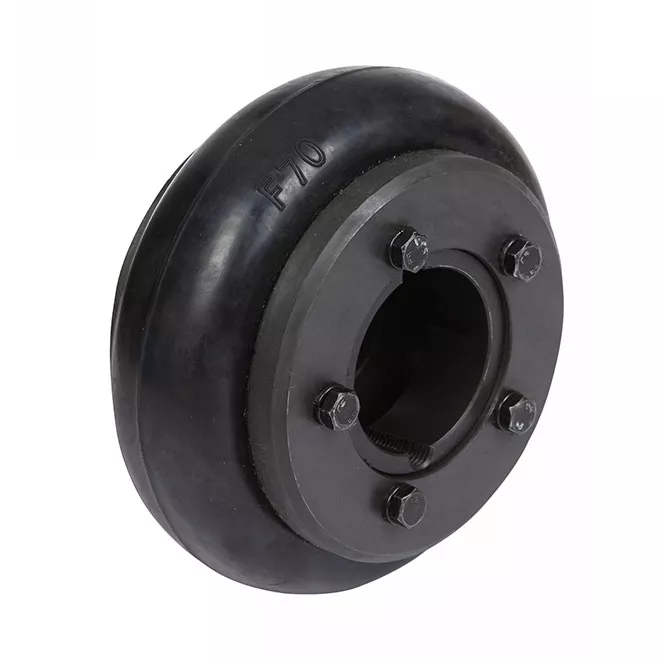
Spacer Coupling – tyre type, F40 to F180 sizes, DBSE 80 to 180 mm. Ever Power Flange Couplings Australia Ltd., Condell Park NSW 2200.
What Defines a Spacer Coupling in Pump Engineering
A spacer coupling differs from a close-coupled flexible coupling in one critical dimension: it places a deliberate length of shaft between the two flexible elements. That spacer length — typically 80 to 180 mm for standard pump applications, or longer for engineering-specific arrangements — creates the back pull-out clearance demanded by API and ANSI centrifugal pump designs. When the pump’s bearing housing slides axially toward the driven end during maintenance, the impeller can be lifted clear of the volute without breaking the motor-side connection.
This single design decision changes how a maintenance team approaches a pump overhaul. Without a spacer coupling, replacing a worn mechanical seal on a horizontal centrifugal pump requires the motor to be unbolted, lifted off its dowels, and stored to one side while the pump bearing housing is withdrawn. With the spacer in place, the motor stays mounted, the alignment dowels remain seated, and only the spacer tube and one flexible element need to be removed — typically a 20-minute task rather than a half-day exercise that risks damaging the alignment baseline.
Why Coupling Selection Affects Total Lifecycle Cost
When the lifecycle cost of a pump set is examined honestly — capital plus electricity plus maintenance over a 15-year service life — the coupling itself represents under 2 percent of the total. Yet the choice of coupling type determines whether each mechanical seal replacement takes 20 minutes or 4 hours, whether the alignment baseline is preserved or restored from scratch, and whether the maintenance crew finishes the shutdown on schedule. The spacer coupling is one of the rare components whose specification at the design stage continues paying back over the entire operating life of the equipment.
How the Spacer Coupling Accommodates Misalignment
Each tyre element on the spacer coupling is moulded from natural or synthetic rubber bonded to two metal end rings, with an internal wire reinforcement wound in both directions to handle reverse-drive torque without unwinding. As the shaft misalignment changes during operation — caused by thermal growth, baseplate flex, or settling foundations — each tyre deflects independently in shear, distributing the misalignment load across the rubber rather than concentrating it at any single shaft component.
The two-flex-plane geometry of the spacer arrangement effectively doubles the misalignment capacity of a single tyre coupling. Where a single F100 tyre coupling tolerates 4° angular at one plane, the equivalent spacer coupling assembly handles a combined angular offset across the two tyres without overloading either rubber element. This is why offshore pump sets, marine engine drives, and remote mining installations specify spacer couplings even when their nominal alignment is excellent — the additional misalignment headroom protects against unplanned baseplate movement.
Tyre Compound Options for Australian Operating Environments
The selection of tyre compound is the second engineering decision after sizing. Standard natural rubber is appropriate for clean, dry industrial environments operating below +80°C — the majority of indoor pump and fan installations. For NSW underground coal mines, FRAS (Fire Resistant Anti-Static) compound is mandated by safety regulations, and the FRAS tyres carry the appropriate certification documentation for site approval. Offshore platforms and petrochemical facilities specify ATEX-certified compounds where hazardous-area classification requires.
Operating range -30°C to +80°C. The default choice for indoor pump and motor drives in NSW manufacturing, water utility, and HVAC applications. Lowest cost per unit and longest service life under benign conditions. Not suitable for oil splash environments — specify NBR upgrade.
Fire Resistant Anti-Static rubber meeting Australian and international underground coal mining safety standards. Mandatory specification for NSW and QLD underground installations including dewatering pumps, conveyor drives, and auxiliary fans. Certificates of conformity available with every shipment.
Tested and certified for use in explosive atmosphere classified zones — offshore platforms, gas processing facilities, fuel handling terminals. Anti-static and flame-retardant properties verified to relevant EN and IEC standards. Required documentation supplied with each order.
Nitrile rubber compound resists petroleum products, mineral oils, and most industrial solvents. Specified where gear oil mist or lubricating oil splash would degrade natural rubber within months. Operating range -40°C to +100°C. Recommended for gearbox-adjacent pump drives.
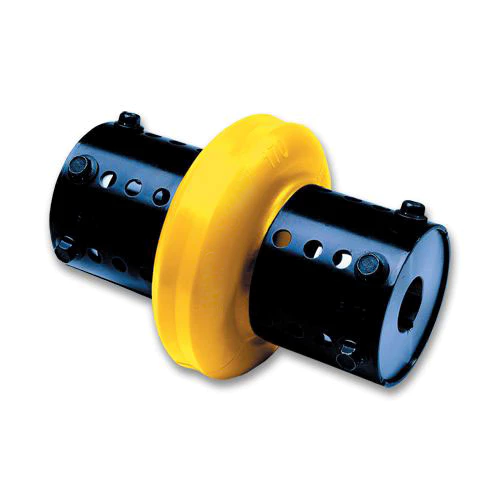
Spacer coupling assembly – two tyre elements with intermediate spacer tube providing DBSE clearance for pump back pull-out maintenance.
Industrial Applications Across Australian Industry
The spacer coupling earns its place as a default pump-set specification across NSW industry because the requirement it solves — maintenance access without motor removal — exists wherever centrifugal pumps need periodic seal replacement. Beyond pumps, the same axial-clearance benefit applies to any driven machine with rotor or impeller wear surfaces that require periodic withdrawal: blowers, separators, and certain gearbox configurations. The application breadth makes the spacer coupling one of the most widely stocked items in our Condell Park warehouse.
Centrifugal Pump Sets — Primary Application
Water and wastewater utility pump stations, industrial process pumps, mine dewatering, irrigation pump houses, and HVAC chilled water pumps across NSW and Australia operate with tyre spacer couplings as the connection between motor and pump shaft. The DBSE dimension is selected to match the pump’s specified back pull-out length — typically 100 or 140 mm for ANSI B73.1 horizontal end-suction pumps and 140 to 180 mm for larger split-case configurations. This matching ensures the motor never needs to be removed for routine maintenance.
Diesel Engine to Driven Machine Drives
On diesel engine to pump, generator, or compressor drives, the spacer coupling provides the misalignment tolerance required by engine mounting compliance — where the engine block flexes under firing torque pulsations — and accommodates the axial growth of the engine crankshaft during warm-up. Marine engine room auxiliary pumps, mine dewatering diesels, and emergency generator sets across Australia typically specify F100 to F140 tyre spacers depending on the engine power rating and ambient temperature range.
Installation and Alignment Best Practice
Correct installation of a spacer coupling determines whether you get the full design service life from each tyre element. The two flex planes are designed to operate within their rated misalignment limits — they will function at higher misalignment, but tyre life shortens proportionally. Aligning the drive to within half the rated tolerance values typically doubles the tyre element service life compared to running near the rated maximum.
Verify shaft journals are free of damage, burrs, and corrosion. Confirm keyway dimensions match coupling hub specifications. Clean both shaft and hub bores to bare metal — no oil film, no protective coating residue.
Mount each hub onto its respective shaft, keyed in correct rotational orientation. Slide axially to the position where the assembled tyre element will sit central between hub faces with no compression or tension.
Bring motor and driven machine to approximate alignment using straight edge and feeler gauges. Check angular alignment by measuring gap at four points around the coupling circumference; check parallel offset by laying a straight edge across both hubs.
Use reverse-dial-indicator or laser alignment to bring final angular alignment below 0.2° and parallel offset below 0.1 mm. Both values are well below the coupling’s rated capacity — this margin is what extends tyre service life from 2 years to 8 years in identical service.
Slide the spacer tube into position between the hubs. Locate the first tyre element over its hub bolts, then bolt the spacer tube to that tyre. Repeat for the second tyre. Torque all fasteners to the specified value in the documentation pack.
Run up to operating speed and check for unusual vibration. Inspect after 50 hours: any heating of tyre elements, oil seepage from adjacent equipment, or unexpected vibration indicates misalignment beyond rated values — investigate before continuing service.
Request a Spacer Coupling Quote
OEM Compatibility and Cross-Reference
Our spacer coupling range is designed to the established dimensional standard widely used across Australian industry. Direct cross-reference is available for Fenner Fenaflex spacer couplings, Transfluid tyre spacer couplings, and equivalent designs from other major brands. When replacing a worn unit on existing pump infrastructure, provide us with the original equipment manufacturer model code, the DBSE dimension, and the bore sizes at each end — our Sydney technical team confirms the equivalent Ever Power size before quoting, eliminating fit surprises on site.
Tyre elements are stocked separately at our Condell Park warehouse, which means a routine tyre replacement on a worn pump coupling does not require purchasing a complete coupling assembly. This separate-element-stocking policy is one of the practical reasons the spacer coupling continues to dominate pump-set specifications across NSW: the lifecycle replacement cost is restricted to the rubber element, while the cast iron and steel hubs serve the full equipment lifetime.
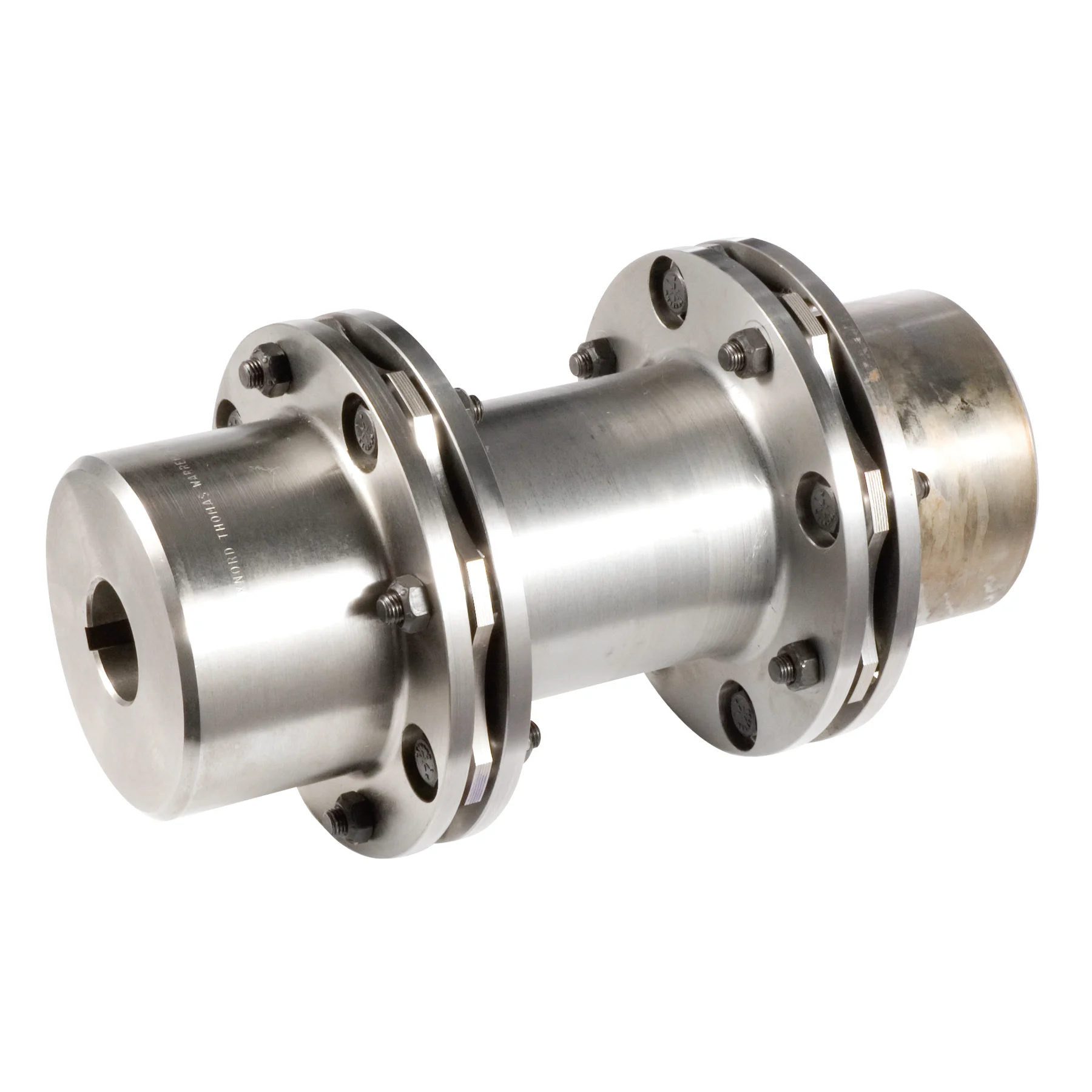
Tyre element field replacement – the spacer tube and one tyre are withdrawn axially without disturbing motor alignment.
Why Choose Ever Power Australia
Ever Power Flange Couplings Australia Ltd. is a specialist flange coupling supplier serving New South Wales and Australia from our Condell Park, Sydney warehouse. The complete spacer coupling range from F40 to F180, in all standard DBSE values and all four tyre compound grades, is stocked locally. Same-day dispatch is available for orders confirmed before 2 pm AEST on weekdays. Custom DBSE values, non-standard bore configurations, and OEM cross-reference work are handled by our in-house engineering team without the lead time penalty of overseas supply chains.

Ever Power manufacturing facility — ISO 9001 certified, 12,000 m², 108 dedicated coupling machines, 20+ years of production experience.
Every order placed with our Sydney team is backed by full material traceability, dimensional inspection certificates on request, and direct access to the engineers who specified, machined, and packed your coupling. We do not subcontract technical support — when you phone +61 2 9708 3322 during NSW business hours, you reach the people who actually know the product.
Frequently Asked Questions
Quick answers from our Sydney technical team. Contact us for application-specific guidance.
1. How do I select the correct DBSE for my centrifugal pump? +
2. Can I replace just the tyre element without buying a whole coupling? +
3. Is FRAS compound mandatory for NSW underground mining? +
4. What is the typical service life of a spacer coupling tyre element? +
5. How quickly can I receive a spacer coupling from your Sydney warehouse? +
Request a Quote — Sydney NSW Stock
Tell us your motor power, shaft diameter, and operating environment. Our New South Wales coupling team confirms availability and pricing within one business day, with same-day dispatch on standard sizes from Condell Park.
Ever Power Flange Couplings Australia Ltd. · 27 Harley Crescent, Condell Park NSW 2200 · [email protected]