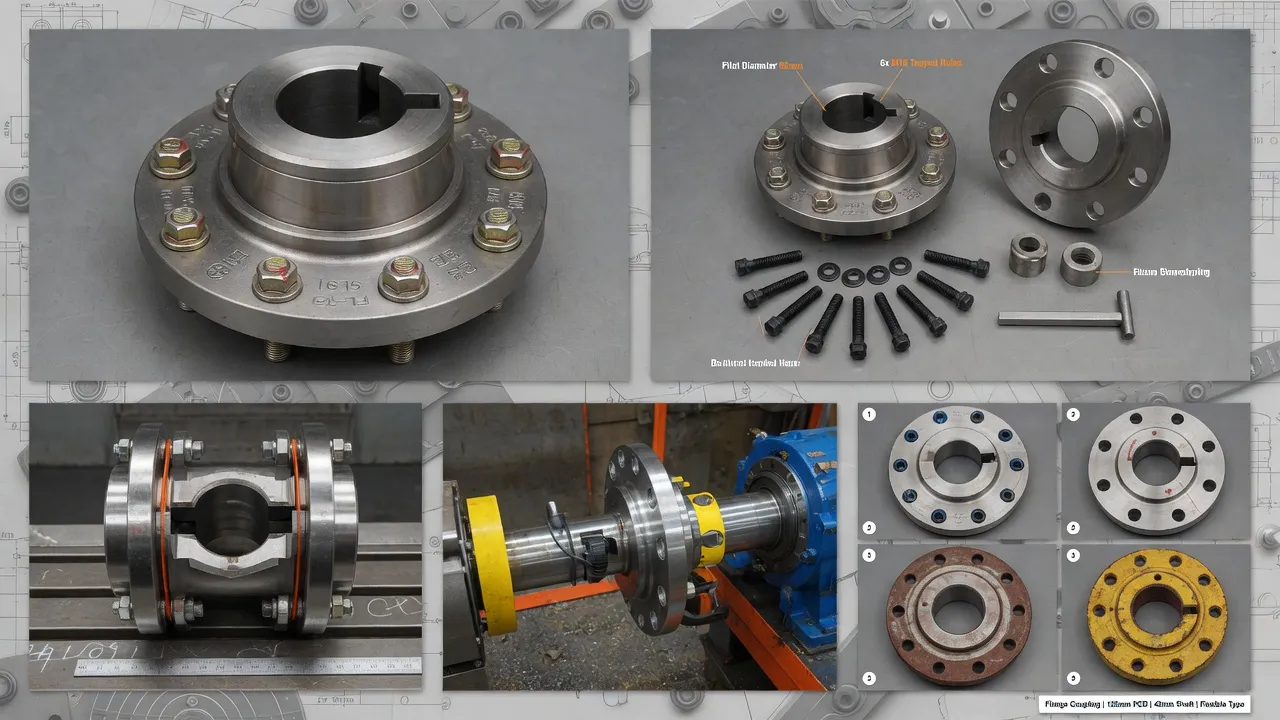
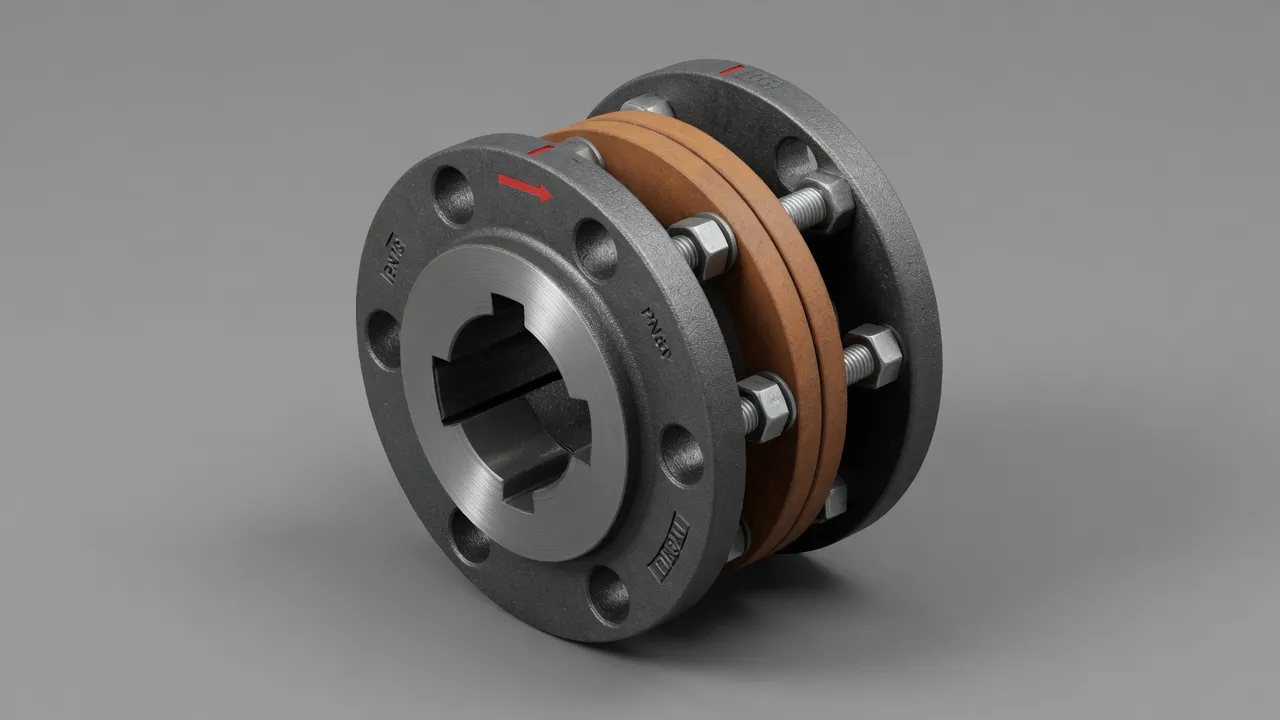
Torsional stiffness is the coupling characteristic that most directly determines how a drivetrain responds to dynamic loading — whether it isolates vibration or transmits it, whether it resonates or stays damped, whether a servo drive achieves its positioning accuracy or exhibits control lag. Yet torsional stiffness appears in coupling datasheets as a single number in Nm/rad and is frequently overlooked in favour of the more familiar torque rating and bore size. This guide explains what torsional stiffness is, why it matters for every coupled drivetrain from servo motors to pump drives, and how to use it in practice to select the correct coupling and avoid torsional resonance. The contrast between the disc coupling (very high torsional stiffness, near-rigid) and the flexible tyre coupling (medium to low stiffness, vibration-isolating) illustrates the engineering trade-offs that torsional stiffness selection represents.
What Torsional Stiffness Is — and What It Is Not
Torsional stiffness (kt) is the relationship between the torque applied across the coupling and the angular deflection of the output shaft relative to the input shaft. A coupling with kt = 2,000 Nm/rad will show an output-to-input angular lag of 1 radian (57.3°) when transmitting 2,000 Nm. In practice, coupling torsional deflections are much smaller than this — a few tenths of a degree at most under normal operating torque — but the stiffness value still determines the system’s dynamic behaviour.
Torsional stiffness is not the same as flexural stiffness (resistance to bending), radial stiffness (resistance to lateral displacement), or axial stiffness (resistance to axial displacement). These are separate coupling characteristics that appear on separate lines in the coupling datasheet. A coupling can have low torsional stiffness (flexible in the rotational direction) but high radial stiffness (rigid against lateral displacement) — indeed, this combination is the design intent of most elastomeric coupling designs.
Torsional Stiffness Values Across Common Coupling Types
Coupling Type
Typical kt Range (Nm/rad)
Relative Stiffness
Primary Application
F-type flexible tyre (80A PU)
200–5,000
Very Low
Maximum vibration isolation — pumps, fans on flexible bases
The Torsional Natural Frequency — Where Stiffness Becomes Critical
Every coupling-drivetrain system has a torsional natural frequency — the frequency at which the motor inertia and load inertia will oscillate relative to each other through the coupling’s torsional spring if excited. When an external excitation frequency (from the motor, load, or VSD) matches this natural frequency, resonance occurs and torsional vibration amplitude is amplified by the system’s quality factor (typically 5–15 for elastomeric couplings, 20–100 for metallic couplings).
Natural frequency formula: fn = (1/2π) × √(kt / Jeq)
Where Jeq = (J1 × J2) / (J1 + J2) — the equivalent inertia of the two-mass system
Practical example: Motor J = 0.05 kg·m², pump J = 0.03 kg·m², coupling kt = 5,000 Nm/rad Jeq = (0.05 × 0.03) / (0.05 + 0.03) = 0.01875 kg·m² fn = (1/2π) × √(5,000 / 0.01875) = 82 Hz — well above the pump excitation frequency range
Using Torsional Stiffness to Choose the Right Coupling
1
Identify the Primary Design PriorityIs the coupling primarily for vibration isolation (pump, fan, reciprocating machine), speed/position accuracy (servo, encoder, CNC), or high-torque transmission with shock absorption (crusher, mill, conveyor)? The priority determines the stiffness region: low for isolation, very high for precision, medium-high for shock absorption.
2
Calculate the Required Torsional Natural FrequencyThe natural frequency should be either well below the lowest significant excitation frequency (for isolation — ratio > 1.4 recommended) or well above the highest significant excitation frequency (for stiff coupling — ratio > 2.0). For standard 4-pole motor at 1,450 RPM: excitation at 24.2 Hz (running speed). An isolating coupling wants fn below 17 Hz; a stiff coupling wants fn above 48 Hz.
3
Select Coupling Stiffness to Meet the Target Natural FrequencyRearrange the natural frequency formula: kt = (2π × fn)² × Jeq. Calculate the required kt and select a coupling with this stiffness from the datasheet. For F-type tyre couplings, kt increases with coupling size and elastomer hardness — the coupling datasheet lists kt for each size and element grade.
4
Verify at Operating TemperatureCheck that the selected coupling stiffness at the worst-case operating temperature (highest temperature for elastomeric types — softest and lowest natural frequency) still meets the torsional separation target. If the temperature range is wide, re-run the calculation at both temperature extremes.
Frequently Asked Questions
What units is torsional stiffness measured in?+
Torsional stiffness (kt) is measured in Newton-metres per radian (Nm/rad) or Newton-metres per degree (Nm/°). The radian unit is used in engineering calculations and torsional analysis software. The degree unit is sometimes more intuitive for interpreting datasheets — a coupling with kt = 1,000 Nm/° means the output shaft will lag behind the input shaft by 1° for every 1,000 Nm of applied torque. To convert: multiply Nm/° by 57.3 to get Nm/rad.
How does elastomeric element hardness affect torsional stiffness?+
Higher Shore hardness elastomers produce higher torsional stiffness. As a general guideline for F-type tyre couplings: 80A Shore PU provides the lowest stiffness (highest flexibility, most vibration isolation); 92A Shore PU provides medium stiffness (standard grade for most applications); 98A Shore PU provides the highest stiffness among standard elastomeric grades. The relationship is approximately exponential — going from 80A to 92A typically doubles the torsional stiffness; going from 92A to 98A approximately doubles it again. Exact values are in the coupling datasheet for each size.
Is higher torsional stiffness always better?+
No. Higher torsional stiffness is better when positioning accuracy and speed control precision are the primary requirements — servo drives, CNC axes, and encoder connections where torsional compliance introduces lag. Lower torsional stiffness is better when vibration isolation is the priority — pump drives, reciprocating compressor drives, and building HVAC applications where torsional excitation from the motor or driven machine must be attenuated before reaching the bearings. Most general industrial applications benefit from a medium stiffness that provides some vibration isolation without excessive torsional compliance.
How do I use torsional stiffness to calculate the natural frequency?+
The torsional natural frequency of a two-inertia system: fn = (1/2π) × √(kt × (J1 + J2) / (J1 × J2)), where kt is the coupling torsional stiffness in Nm/rad, J1 is the motor rotational inertia in kg·m², and J2 is the driven machine rotational inertia in kg·m². For a pump drive: motor inertia is in the motor datasheet; pump inertia can be estimated from the pump’s impeller dimensions and mass; coupling torsional stiffness is in the coupling datasheet. This formula gives the natural frequency in Hz — compare to the excitation frequencies in the operating speed range to identify resonance risk.
Does temperature affect a coupling’s torsional stiffness?+
Yes, significantly for elastomeric couplings. Polyurethane and natural rubber elastomers become stiffer at lower temperatures and softer at higher temperatures. A PU coupling element at 0°C may have 30–50% higher torsional stiffness than the same element at 40°C ambient temperature. This temperature dependence means that a coupling system near resonance at operating temperature may be further from resonance at start-up (cold), or vice versa. For applications near torsional resonance, specify the coupling stiffness at the worst-case temperature condition — typically the highest ambient temperature, where the elastomer is softest and the natural frequency is lowest.
Need Expert Coupling Advice?
Our engineering team in Condell Park NSW is ready to help — free of charge.