The MH coupling occupies a specific and useful position in the flexible coupling catalogue — between the jaw coupling (lighter, simpler, lower torque) and the pin-and-bushing LT series (heavier, higher torque, more pins). Its flanged hub design with a central elastomeric element provides vibration damping, no-lubrication maintenance, and a compact axial profile that suits conveyor, mixer, and packaging machine drives where the physical space for a larger tyre or flange coupling is not available. This guide explains how the MH coupling works, how it compares to the NM coupling and other elastomeric coupling types, and where it is the natural specification choice across Australian industrial applications.
How an MH Coupling Works
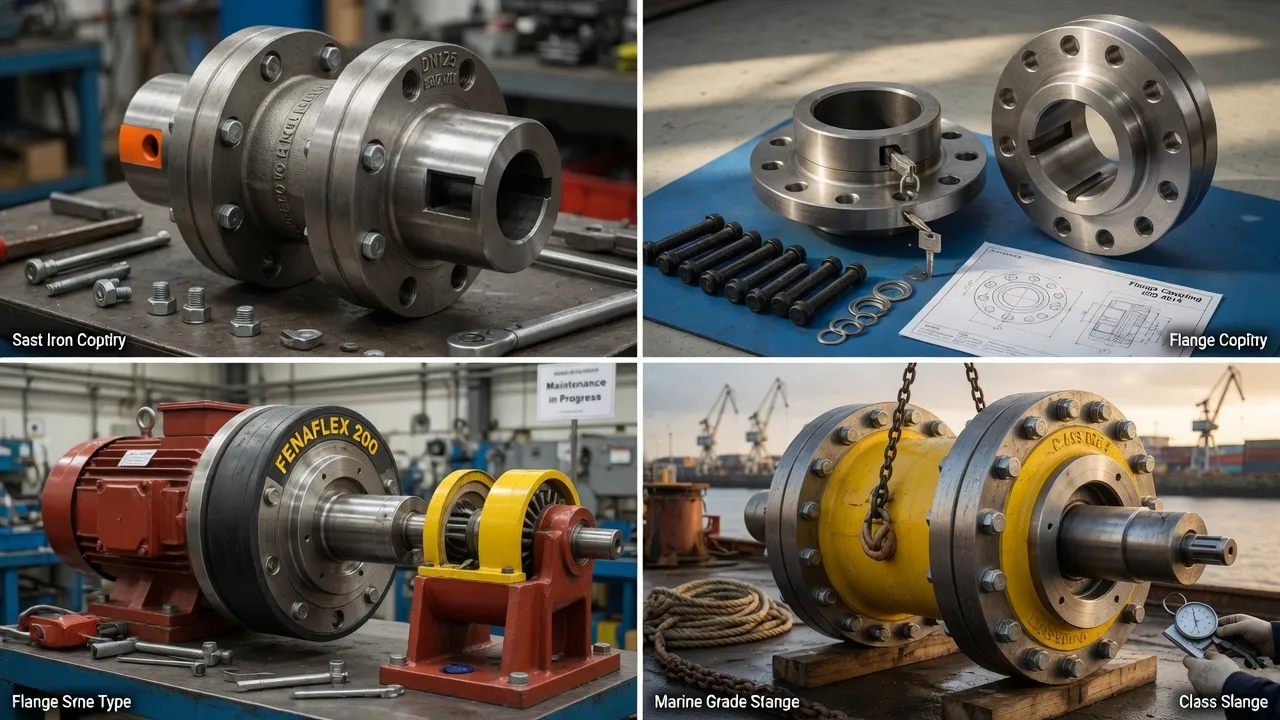
An MH coupling consists of two machined metal hubs with mating flanged faces, and an elastomeric element compressed between them in the coupling’s axial direction. Unlike a jaw coupling where the spider element sits between interlocking jaw teeth, the MH element sits in a central cavity formed by the two hub faces when they are brought together. Torque is transmitted from one hub to the other through shear and compression of this central element as the two flanges rotate relative to each other under load.
This design produces a very compact axial coupling length compared to a tyre-type flexible coupling, because the elastomeric element is sandwiched axially between the two hub flanges rather than wrapped around the outside of the hubs. The compact profile makes MH couplings particularly useful in space-constrained drive systems where a longer tyre coupling would not fit within the available DBSE.
MH vs NM Coupling — Key Differences
| Feature | MH Coupling | NM Coupling |
|---|---|---|
| Torque Range | 30 Nm – 3,500 Nm | 30 Nm – 4,500 Nm |
| Bore Range | 14 mm – 90 mm | 14 mm – 100 mm |
| Element Position | Central axial element between hub flanges | Outer jaw elements between interlocking hub jaws |
| Axial Profile | Compact — element does not extend beyond hub OD | Standard — jaw elements extend beyond hub body |
| Misalignment Tolerance | Angular: 1.0°, Parallel: 0.4 mm | Angular: 1.0°, Parallel: 0.5 mm |
| Element Replacement | Hub separation required to access central element | Hub separation required — similar to MH |
| Space Constraint Suitability | Better — compact axial profile | Standard |
| Best Application | Space-constrained drives; conveyor, mixer, packaging | General motor-pump and conveyor drives |
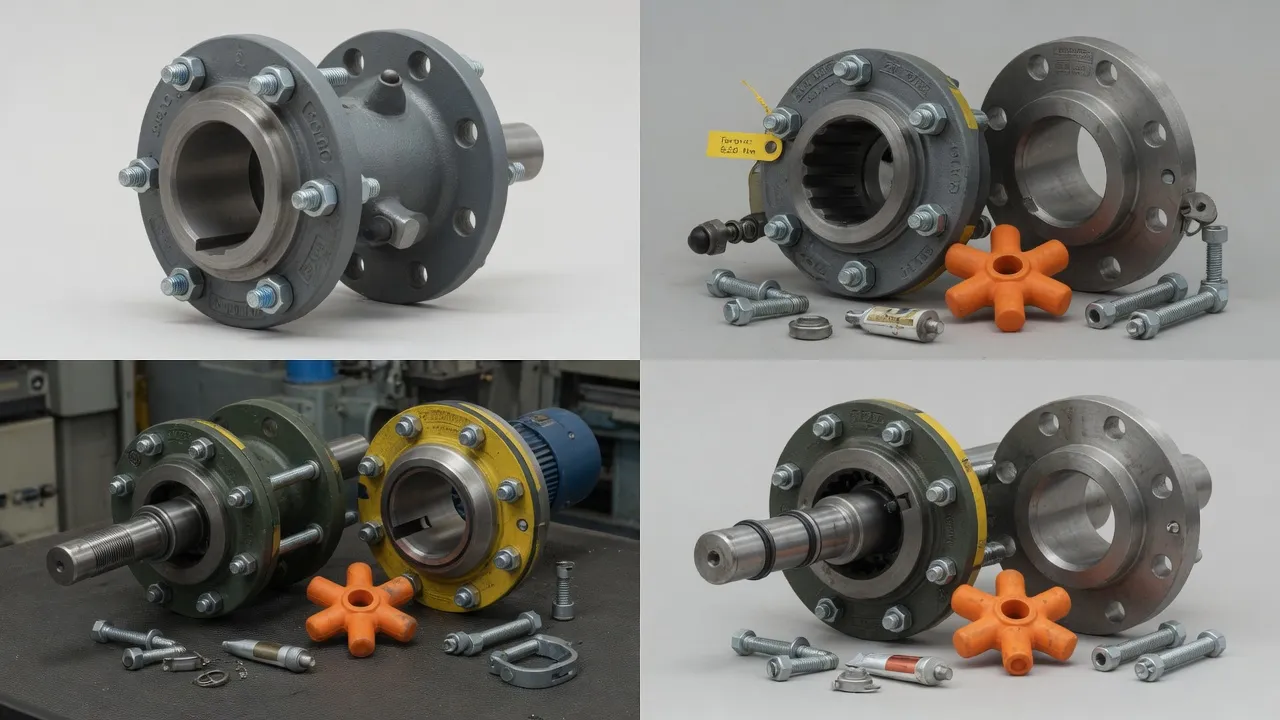
MH Coupling vs Jaw Coupling vs F-Type Tyre — Three-Way Comparison
| Criterion | MH Coupling | Jaw Coupling (L-series) | F-Type Tyre Coupling |
|---|---|---|---|
| Max Torque (same bore) | Medium | Lower | Higher (larger overall size) |
| Axial Length | Compact | Standard | Larger (tyre element outside hubs) |
| Misalignment Tolerance | 1.0°, 0.4 mm | 1.0°, 0.5 mm | 4.0°, 3.0 mm |
| Vibration Damping | Good | Good | Best (largest element volume) |
| Element Replacement | Hub separation needed | Hub separation needed | Hub separation + tyre removal |
| Space-Critical Drives | Best choice | Standard | Largest footprint |
| Typical Application | Conveyors, packaging, mixers in tight spaces | Light motor-pump, HVAC | Pump, fan, compressor — general industrial |
Where MH Couplings Are Specified in Australian Industry
Packaging and Material Handling
Packaging line conveyors, filling machine drives, and label applicator connections use MH couplings where the compact profile fits within the tight mechanical envelope of the machine frame. The element’s vibration damping also protects precision filling and weighing mechanisms from motor vibration.
Food Processing and Beverage
Mixer and blender drives in food processing where a compact, food-grade elastomeric element is required. MH coupling with FDA-compliant PU element in a smooth hub profile suits hygienic requirements.
Material Handling Equipment
Roller conveyor drives, sortation equipment, and palletiser drives use MH couplings where multiple drives are closely spaced and a larger coupling would conflict with adjacent equipment. The compact axial profile saves critical space between conveyor roller centres.
General Manufacturing
Motor-to-gearbox connections on press brakes, CNC coordinate tables, and light industrial machine tools where the bore range and torque level match the MH series and a tyre coupling would be physically oversized for the available space.
Frequently Asked Questions
Need Expert Coupling Advice?
Our engineering team in Condell Park NSW is ready to help — free of charge.