A universal coupling — also called a universal joint, Cardan coupling, or U-joint — solves a problem that standard rigid and flexible couplings cannot: power transmission between two shafts that are significantly angled relative to each other, with angular misalignment from 3° to 25° or more. Standard flexible flange couplings accommodate misalignment of 1°–4° through elastomeric element deformation. Universal couplings use articulated cross-pin joints to accommodate misalignment angles far beyond any elastomeric design, making them the only practical solution for rolling mill drives, forging press spindles, steel plant auxiliary drives, and industrial gear train connections where large angular offsets are inherent to the machine design. The EP-SWC series universal coupling and the SWP-B short flex type universal coupling cover the full range of torque and misalignment requirements in Australian heavy industry.
How a Universal Coupling Transmits Torque at an Angle
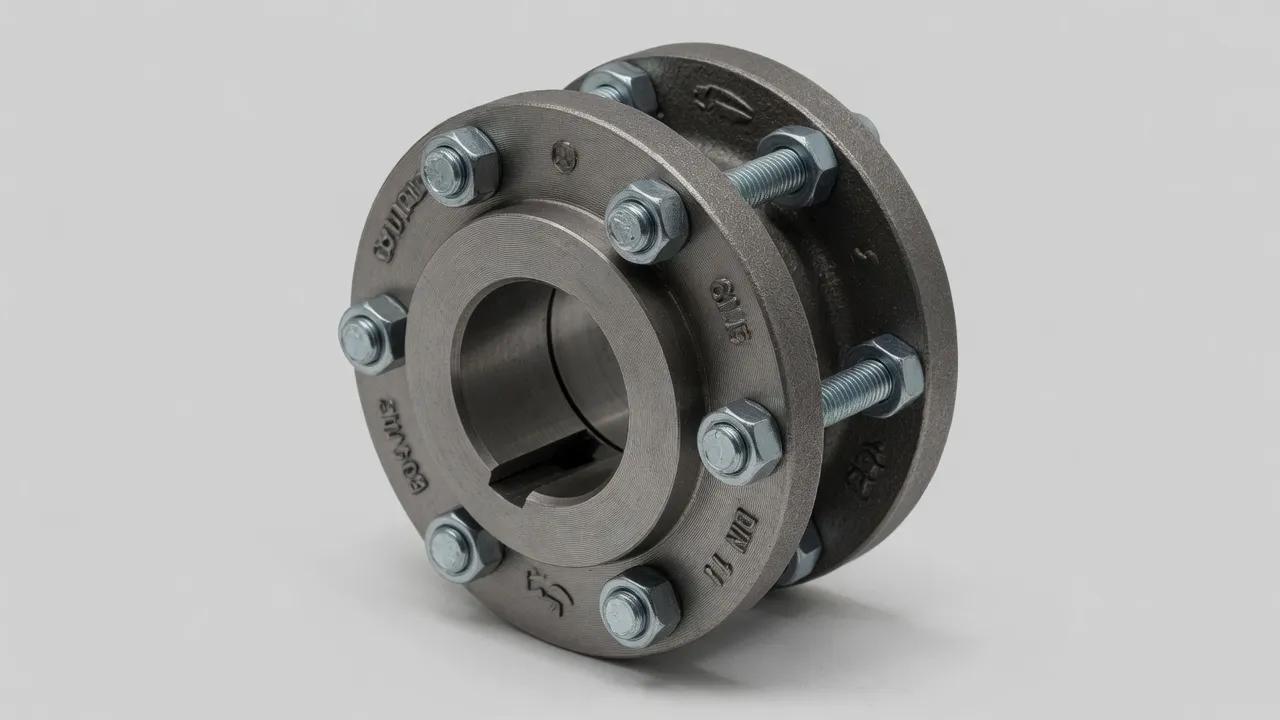
The operating principle of a universal coupling is the cross-pin (or spider) joint. A machined steel cross-piece — with four perpendicular trunnion pins — fits into needle roller or plain bushing bearing cups in two forked yokes, one connected to the input shaft and one to the output shaft. When the input yoke rotates, the cross-pin transmits torque to the output yoke through the bearing cups on the perpendicular pair of trunnions. Because the cross-piece can pivot simultaneously in two planes (the two pairs of trunnions), the coupling transmits torque at any angle the joint geometry permits.
The fundamental engineering limitation of a single universal joint is the velocity non-uniformity it introduces at non-zero angles. For this reason, industrial universal coupling assemblies (Cardan shafts) always use two joints in series — one at each end of a connecting shaft — with the yokes phased so that the velocity variation from the first joint is cancelled by the second joint. The SWC and SWP series from Ever Power are double-joint assemblies that deliver constant velocity output at their rated operating angles.
SWC vs SWP Series — Which Universal Coupling Fits Your Application?
| Series | Type | Bore Connection | Max Angle | Torque Range | Best Application |
|---|---|---|---|---|---|
| SWC-BH | Standard flex, welding type | Shaft welded to yoke | 15° | 500–800,000 Nm | Rolling mills, heavy industrial drives |
| SWC-CH | Long flex, welding type | Shaft welded to yoke | 15° | 500–800,000 Nm | Long-distance drives requiring large DBSE |
| SWC-BF | Standard flex, flange type | Bolted to standard flange | 15° | 500–800,000 Nm | Drive systems with removable motor connections |
| SWP-A | Long flex type | Flange or welded | 25° | 200–500,000 Nm | High-angle drives: forging press, hot rolling |
| SWP-B | Short flex type | Flange or welded | 25° | 200–500,000 Nm | Compact high-angle drives in tight spaces |
| SWP-E | Long flex, double flange | Double flange both ends | 25° | 500–500,000 Nm | Drives requiring flange connection at both ends |
Industries Where Universal Couplings Are Essential
Steel Rolling Mills
Roll stands require power transmission through large angular changes as roll gap adjusts. Universal couplings (spindles) are the only technology that handles the combination of very high torque and continuous angular variation. SWC-BH series is the industry standard.
Forging Presses
Eccentric press drives require universal couplings to connect the motor-gearbox output to the eccentric mechanism across varying angular positions through each press stroke. SWP-A long flex type handles the high angular deviation.
Paper and Pulp Machinery
Dandy rolls, calender stacks, and winder drives require universal couplings to accommodate the angular offsets inherent in multi-roll press nip configurations. Lower torque than steel plant but requires precision velocity uniformity.
Mining Screening Equipment
Vibrating screens use eccentric drives that require universal couplings between the motor and the eccentric shaft. The coupling must handle both the angular offset and the cyclic torque variation from the eccentric mechanism.
Installation and Maintenance Requirements
Universal couplings require more careful installation attention than standard flange couplings. The two joints at each end of a Cardan shaft assembly must be phased correctly — the input and output yokes must be in the same angular position relative to the shaft tube when the assembly is assembled. Incorrect phasing produces velocity non-uniformity rather than cancelling it, which creates significant torsional vibration at twice the shaft speed. Most SWC and SWP assemblies are marked with alignment indicators at the factory to prevent phasing errors during field installation.
Frequently Asked Questions
Need Expert Coupling Advice?
Our engineering team in Condell Park NSW is ready to help — free of charge.