Description
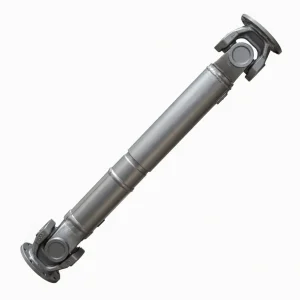
The SWC-WF is the long-body without-flex flange-type configuration of the SWC universal coupling family — built around two bending joints in series that allow operating angles up to 90 degrees between input and output shafts. This heavy duty shaft coupling handles the extreme-angle drives common in metallurgy, lifting and hoisting equipment, mining, petroleum, shipbuilding, coal, rubber, and paper machinery. The flanged hub interface supports field-removable installation; the without-flex construction delivers maximum torsional stiffness at the operating angle.
SWC-WF Specifications and Dimensional Range
The SWC-WF range covers gyration diameters from 100 mm to 490 mm. Maximum operating angle reaches 90 degrees through the double-joint geometry — each Hooke’s joint operating at up to 45 degrees. The flange interface follows standard industrial bolt-circle and pilot-diameter conventions. Torque ratings match the SWC-WH and SWC-WD equivalents at any given gyration diameter.
| Model | Gyration Ø D (mm) | Nominal Torque Tn (kN·m) | Fatigue Tn Tf (kN·m) | Flex Angle β (°) | Bore D₂ (mm) | Lmin (mm) |
|---|---|---|---|---|---|---|
| SWC100WF | 100 | 1.25 | 0.63 | ≤90° | 20–44 | 210 |
| SWC150WF | 150 | 4.5 | 2.25 | ≤90° | 30–65 | 275 |
| SWC200WF | 200 | 16 | 8.0 | ≤90° | 40–95 | 340 |
| SWC250WF | 250 | 35 | 17.5 | ≤90° | 55–115 | 410 |
| SWC285WF | 285 | 71 | 35.5 | ≤90° | 75–130 | 450 |
| SWC315WF | 315 | 112 | 56 | ≤90° | 85–150 | 510 |
| SWC390WF | 390 | 224 | 112 | ≤90° | 100–175 | 590 |
| SWC490WF | 490 | 450 | 225 | ≤90° | 135–220 | 700 |
The 90-degree maximum operating angle dramatically exceeds the typical 5-to-25-degree envelope of single-joint flange-type couplings. This wider envelope opens applications where the shaft geometry demands extreme angular relationships — articulated rolling stock, large-angle mining drives, and offset-shaft heavy machinery arrangements all benefit from the double-joint capability.
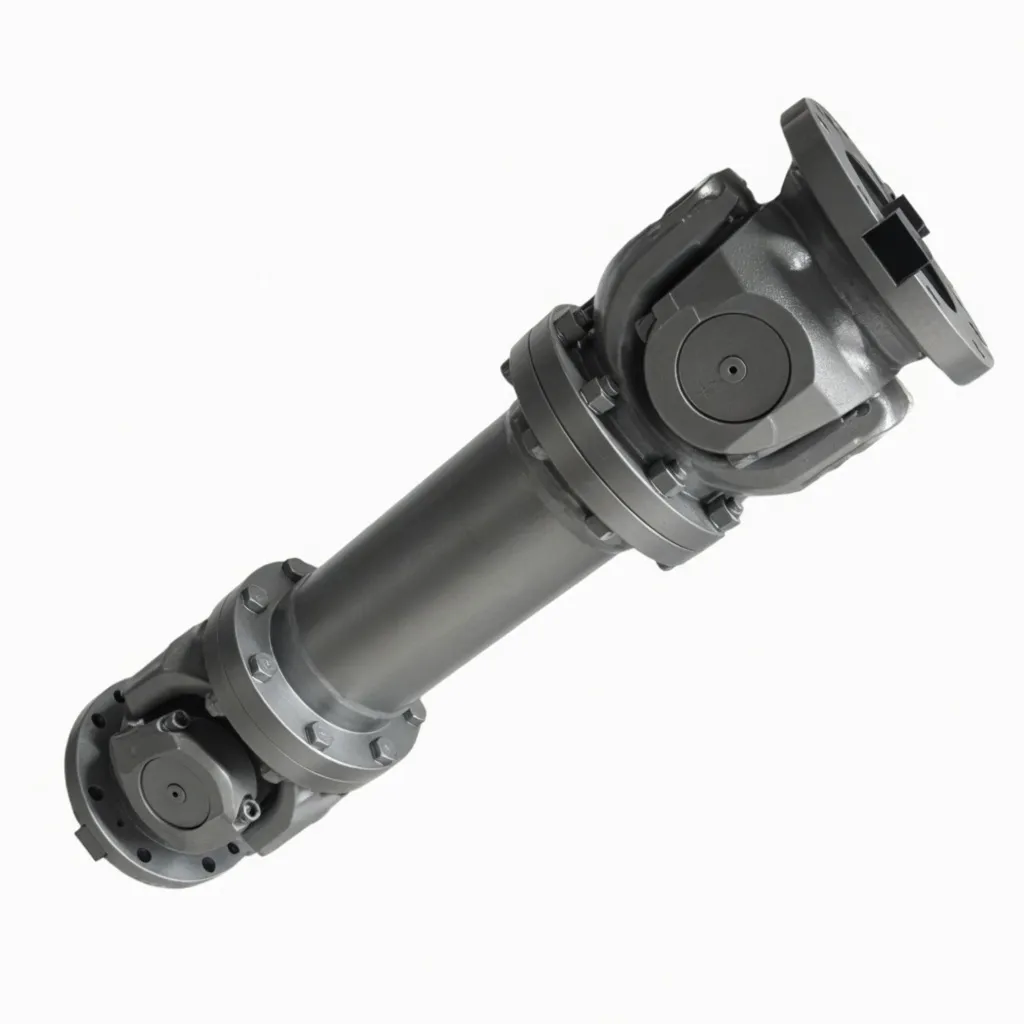
SWC-WF Without Flex Flange Type Universal Coupling – double Hooke’s joint, up to 90 degree operating capability. Ever Power Flange Couplings Australia Ltd.
What Distinguishes the SWC-WF from Other Universal Joint Types
The defining engineering choice in the SWC-WF is the double Hooke’s joint geometry. Two universal joints operate in series with a short rigid intermediate section between them. By splitting the total operating angle between two joints, each joint operates at half the total angle — keeping individual joint angles within their material and bearing-life envelope while delivering total operating angles up to 90 degrees. This is the same geometric principle used in automotive driveshafts and articulated industrial vehicle drivelines.
The without-flex construction eliminates the telescoping intermediate spline that flex variants use to accommodate axial movement. For applications where the shaft-centre distance remains dimensionally stable during operation — bolted-down rigid foundations, articulated joints that fix the geometry — this delivers maximum torsional stiffness. Where axial movement is expected, a flex variant should be specified instead.
Constant-Velocity Operation Through Equal Joint Angles
For constant-velocity power transmission, both Hooke’s joints must operate at equal angles in opposite directions. When this condition is met, the input and output shafts rotate at the same angular velocity even when the overall coupling operates at large total angles. This is the mathematical basis of the SWC-WF’s smooth power transmission at angles where single-joint couplings would generate substantial second-order velocity ripple in the output shaft rotation.
Construction and Material Specification
Material specification follows the SWC family standard: 35CrMo alloy steel forging, full quench-and-temper heat treatment, induction-hardened trunnion journals to HRC 58-64. The double-joint construction uses four trunnion crosses (two per Hooke’s joint) supported on sealed needle roller bearings — twice the bearing count of single-joint variants, with proportionally distributed bearing loading at the operating angle.
The intermediate body between the two joints is a forged-and-machined rigid component that carries the inner yokes of each Hooke’s joint. The flanged hub interface follows the same standard industrial flange convention used across the SWC flange-type range. Bolt torque, locking compound, and inspection routines are identical to the SWC-BF and SWC-WD installation procedures.
90 Degree Operating Angle Capability
Double Hooke’s joint geometry handles total operating angles up to 90 degrees. Each joint operates at half the total angle, keeping individual joint loading within design limits even at extreme overall articulation.
Bolt-On Flanged Hub Connection
Field-removable installation without welding. Standard industrial flange interface supports direct retrofit on existing flanged shaft installations and periodic removal for maintenance routines.
Without Flex Construction
No telescoping spline element. Maximum torsional stiffness at the operating angle. Suitable for applications with dimensionally stable shaft-centre distance and rigid foundation mounting.
35CrMo Alloy Steel Construction
Four trunnion crosses (two per Hooke’s joint) in induction-hardened 35CrMo. Proportionally distributed bearing loading at the operating angle through the double-joint geometry.
Sealed Needle Roller Bearings — All Four Joints
All bearings pre-lubricated at assembly. Lifetime sealing through the design service life under normal operating conditions.
Industrial Flange Standard Interface
Bolt circle, pilot register, and hub face follow widely-used industrial flange conventions. Direct retrofit compatibility with most existing double-joint flanged universal coupling installations.
Industrial Applications Across Heavy Industry
SWC-WF applications cluster around extreme-angle industrial drives where single-joint couplings cannot handle the required total operating angle. The 90-degree double-joint capability opens applications in metallurgy, lifting and hoisting, mining, petroleum, shipbuilding, coal handling, rubber processing, and paper machinery.
Metallurgy and Lifting Equipment Drives
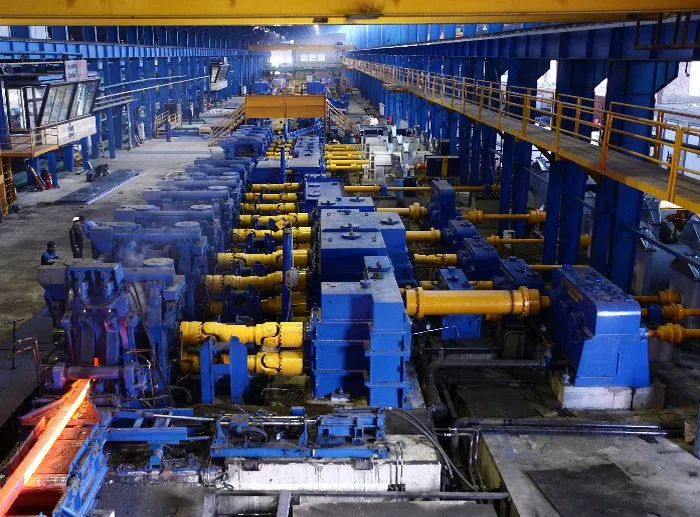
Steel plant drives where the work roll or driven roller is offset substantially from the gearbox output specify SWC-WF couplings for the high-torque double-joint capability. Lifting and hoisting equipment with articulated boom geometry similarly benefits from the wide operating angle envelope. Container terminal lifting cranes, steel mill ladle handling drives, and mine site lifting equipment all match this application profile.
Mining, Shipbuilding, and Heavy Process Machinery
Underground mining equipment with articulated drivelines, ship-shore loading equipment with variable boom angles, paper machine press section drives, and rubber processing roll drives all specify SWC-WF couplings. The combination of large operating angle, high torque transmission, and bolt-on field-removability makes this industrial shaft coupling variant the engineering default for extreme-angle heavy machinery drives across Australian heavy industry.
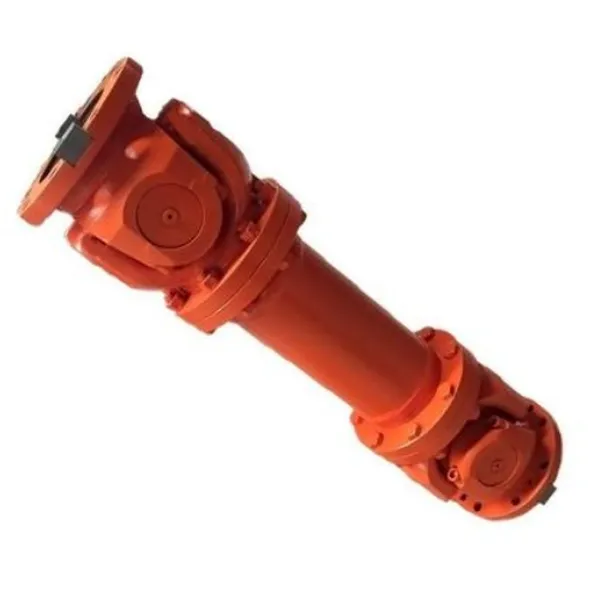
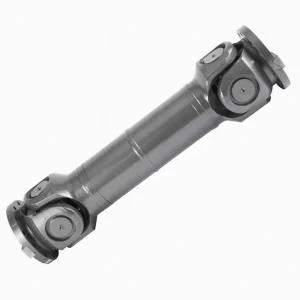
SWC-WF double-joint construction – two bending joints in series for extreme-angle drives.
Selecting the Correct SWC-WF Size for Your Drive
Choose SWC-WF when your application requires operating angles beyond the 25-degree limit of single-joint flange-type variants, with dimensionally stable shaft-centre distance and field-removable installation requirement. The double-joint geometry handles total angles up to 90 degrees while keeping individual joint angles within their fatigue-life envelope. For applications with axial movement, specify a flex variant.
Calculate the total operating angle and verify both Hooke’s joints will operate at the same angle in opposite directions throughout the operating envelope. Constant-velocity operation requires equal-and-opposite joint angles — any geometric asymmetry generates second-order velocity ripple that loads downstream equipment with cyclic torque pulsations.
Installation, Operation, and Maintenance Best Practice
Installation requires precise positioning to maintain equal-and-opposite joint angles throughout the operating envelope. The double-joint geometry is more sensitive to mounting position than single-joint variants — small positioning errors translate to large velocity ripple in the output shaft.
Step 01 — Verify Shaft Geometry
Measure input and output shaft angular orientation and the overall operating angle. Calculate the required joint angle for each Hooke’s joint (half the total angle). Verify both joint angles sit within the 45-degree per-joint envelope.
Step 02 — Confirm Flange Interfaces
Verify existing shaft flange dimensions match SWC-WF hub specifications. Clean flange faces. Apply locking compound to bolt threads if specified.
Step 03 — Position and Engage Pilots
Lift the coupling into position. Engage the pilot register of each hub with the corresponding shaft flange. Verify the intermediate body sits in the correct orientation to deliver equal-and-opposite joint angles.
Step 04 — Install Bolts in Cross Pattern
Install all flange bolts and hand-tighten in a cross pattern at each hub. Apply bolt torque in stages to 30, 60, and 100 percent of final value with a calibrated torque wrench.
Step 05 — Verify Operating Angle Symmetry
Rotate the coupling through one complete revolution by hand. Verify both Hooke’s joints articulate smoothly and operate at equal-and-opposite angles. Any asymmetry must be corrected before commissioning.
Step 06 — Commissioning and Velocity Inspection
Run at progressively increasing speed. Monitor output shaft for velocity ripple — smooth operation confirms equal-and-opposite joint angle setup. Any vibration indicates geometric asymmetry requiring correction before continued service.
OEM Cross-Reference and Order Specification
Cross-reference is available for Voith Turbo double-joint cardan shafts, Rexnord double-joint universal couplings, and SKF wide-angle industrial couplings. Provide OEM model code, gyration diameter, nominal torque, total operating angle, and flange interface dimensions for direct equivalent confirmation from our Sydney engineering team.
Custom intermediate body lengths between the two Hooke’s joints are available for non-standard installation envelopes. Provide a dimensioned drawing of the existing installation geometry for engineering review — typical custom production lead times are 3 to 6 weeks depending on size class and current capacity.
Why Choose Ever Power Australia
Ever Power Flange Couplings Australia Ltd. supplies the SWC-WF double-joint universal coupling range from our Sydney warehouse with commonly specified sizes held in stock. Custom intermediate body lengths and non-standard flange interfaces are handled by our in-house engineering team. Cross-reference work for Voith, Rexnord, and SKF double-joint cardan shaft equivalents is included without additional engineering charges.
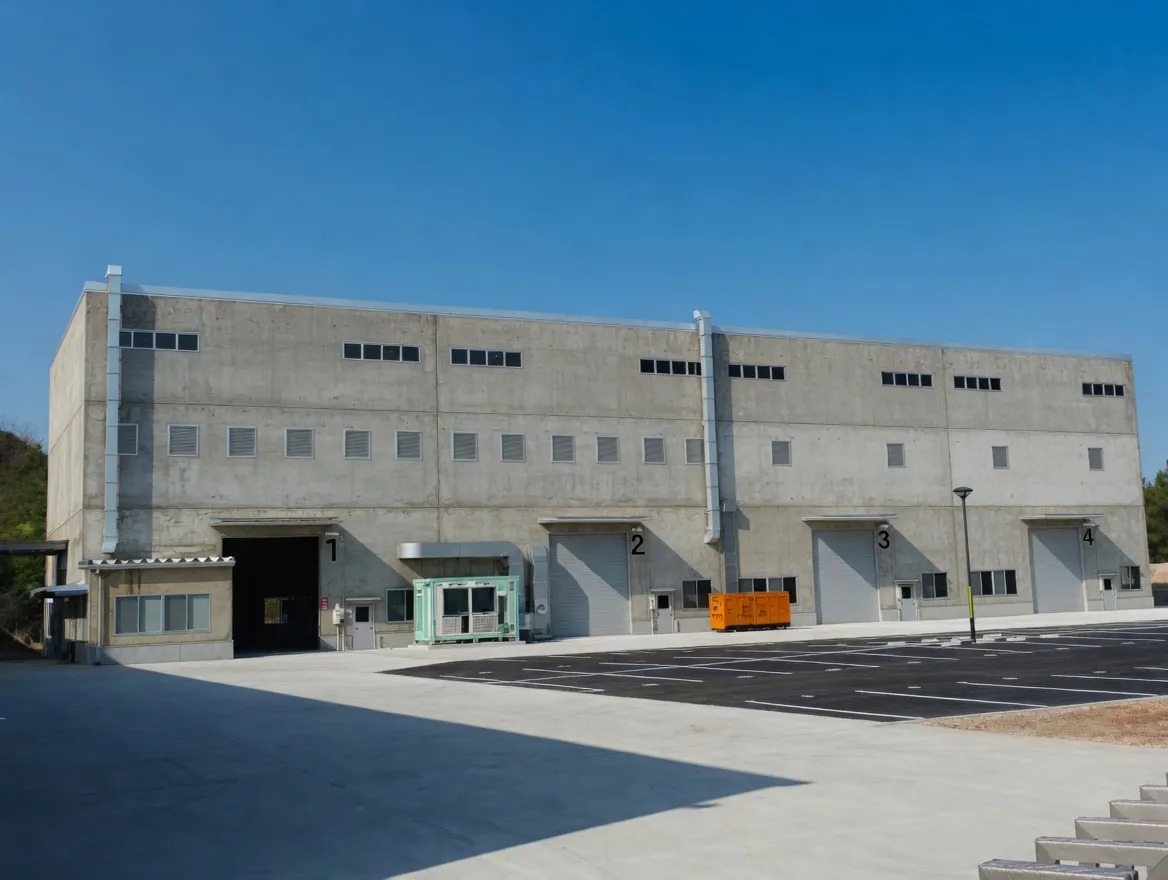
Ever Power manufacturing facility — ISO 9001 certified, 12,000 m², 108 dedicated coupling machines, 20+ years of production experience.
Every order placed with our Sydney team is backed by full material traceability, dimensional inspection certificates on request, and direct access to the engineers who specified, machined, and packed your coupling. We do not subcontract technical support — when you phone +61 2 9708 3322 during NSW business hours, you reach the people who actually know the product.
Frequently Asked Questions
Quick answers from our Sydney technical team. Contact us for application-specific guidance.
1. How is the 90-degree operating angle achieved? +
2. Why must the two joints operate at equal-and-opposite angles? +
3. Can the SWC-WF accommodate axial movement? +
4. What flange interfaces are supported? +
5. How quickly can I receive an SWC-WF from your Sydney warehouse? +
Request a Quote — Sydney NSW Stock
Tell us your motor power, shaft diameter, and operating environment. Our New South Wales coupling team confirms availability and pricing within one business day, with same-day dispatch on standard sizes from Condell Park.
Ever Power Flange Couplings Australia Ltd. · 27 Harley Crescent, Condell Park NSW 2200 · [email protected]