The snake spring coupling — also known as a grid coupling or spring grid coupling — is a coupling type that has been in continuous industrial use for over a century, and for good reason. Its sinusoidal steel spring element provides a combination of shock absorption, misalignment accommodation, and torque capacity that no elastomeric coupling of equivalent size can match. The EP-JSA series snake spring coupling from Ever Power covers the torque range from 120 Nm to 35,000 Nm and is the direct interchangeable equivalent of the Rexnord Falk Steelflex range — the most widely deployed snake spring coupling in Australian industrial applications. For applications where the snake spring’s lubrication requirement is a concern, the EP-GL chain coupling provides a comparable high-torque alternative with sealed lubrication.
The Snake Spring Coupling Operating Principle
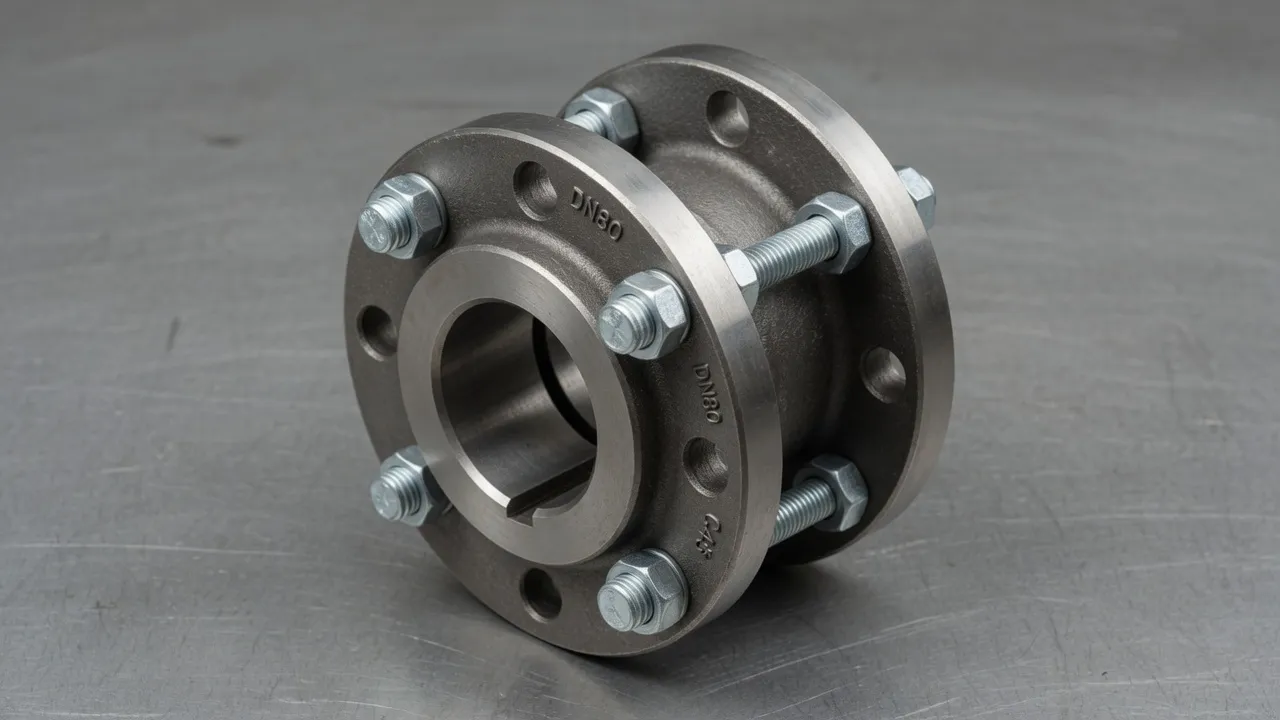
A snake spring coupling consists of two identical hubs, each with a ring of radial teeth machined around its outer circumference, and a single continuous sinusoidal steel spring that weaves between the teeth of both hubs in an alternating pattern. When one hub rotates relative to the other — either under torque loading or misalignment — the spring bends within the tooth slots, transmitting torque through the contact between the spring and the hub tooth flanks.
The progressive stiffness behaviour of the spring is the coupling’s most distinctive engineering characteristic. At zero torque, the spring sits loosely in the tooth slots with minimal contact force. As torque increases, the spring bends more deeply into the slots, increasing the contact arc length and the effective torsional spring rate. This means the coupling becomes stiffer as the load increases — a behaviour that is ideal for shock-absorbing applications because the coupling provides more resistance precisely when the shock peak demands it.
EP-JSA Snake Spring Coupling — Size Reference
| Size | Bore Range (mm) | Rated Torque (Nm) | Peak Torque (Nm) | Angular Tol. (°) | Parallel Tol. (mm) |
|---|---|---|---|---|---|
| JSA-1 | 16–28 | 120 | 360 | 0.75° | 0.50 |
| JSA-2 | 20–38 | 320 | 960 | 1.00° | 0.75 |
| JSA-3 | 28–55 | 750 | 2,250 | 1.00° | 1.00 |
| JSA-4 | 38–75 | 1,800 | 5,400 | 1.25° | 1.25 |
| JSA-5 | 50–95 | 4,200 | 12,600 | 1.25° | 1.50 |
| JSA-6 | 65–120 | 9,500 | 28,500 | 1.50° | 1.50 |
| JSA-7 | 80–160 | 20,000 | 60,000 | 1.50° | 1.75 |
| JSA-8 | 100–160 | 35,000 | 105,000 | 1.50° | 2.00 |
Snake Spring vs Jaw Coupling vs Chain Coupling — Side by Side
| Criterion | Snake Spring (EP-JSA) | Jaw Coupling (L-series) | Chain Coupling (EP-GL) |
|---|---|---|---|
| Peak Torque Capacity | 3× rated — progressive stiffening | 2× rated — constant stiffness | 2.5× rated — metallic engagement |
| Shock Absorption | Excellent — progressive spring stiffness | Good — elastomeric compression | Moderate — chain articulation |
| Lubrication Required | Yes — 6–12 months (sealed: 2–4 years) | No | Yes — 6–12 months (sealed: 2–4 years) |
| Misalignment Tolerance | Moderate — 0.75°–1.5°, 0.5–1.5 mm | Moderate — 1°, 0.5 mm | Moderate — 1°, 0.5–1.0 mm |
| Vibration Damping | Good — spring element dissipates peaks | Good — elastomeric element | Low — metallic engagement |
| Suitable for Food Plant | No — grease required | Yes — no lubrication | No — grease required |
| Typical Application | Conveyor, crusher, mill drives — high shock | Pump, fan, light conveyor — clean environment | Low-speed, high-torque drives |
When to Specify a Snake Spring Coupling Over a Jaw Coupling
The snake spring coupling becomes the preferred choice over a jaw coupling when: the peak torque during start-up or blockage events significantly exceeds the jaw coupling’s rated peak capacity (typically 2× rated for standard 92A spider); the application involves frequent shock loading from material impact or jam events; or the drive speed is too low for an effective fluid coupling but too shock-prone for a standard elastomeric coupling. Conveyor head shafts, bucket elevator drives, crusher secondary drives, and industrial fan drives on direct-on-line starting are the most common Australian applications for the EP-JSA snake spring coupling.
Frequently Asked Questions
Need Expert Coupling Advice?
Our engineering team in Condell Park NSW is ready to help — free of charge.