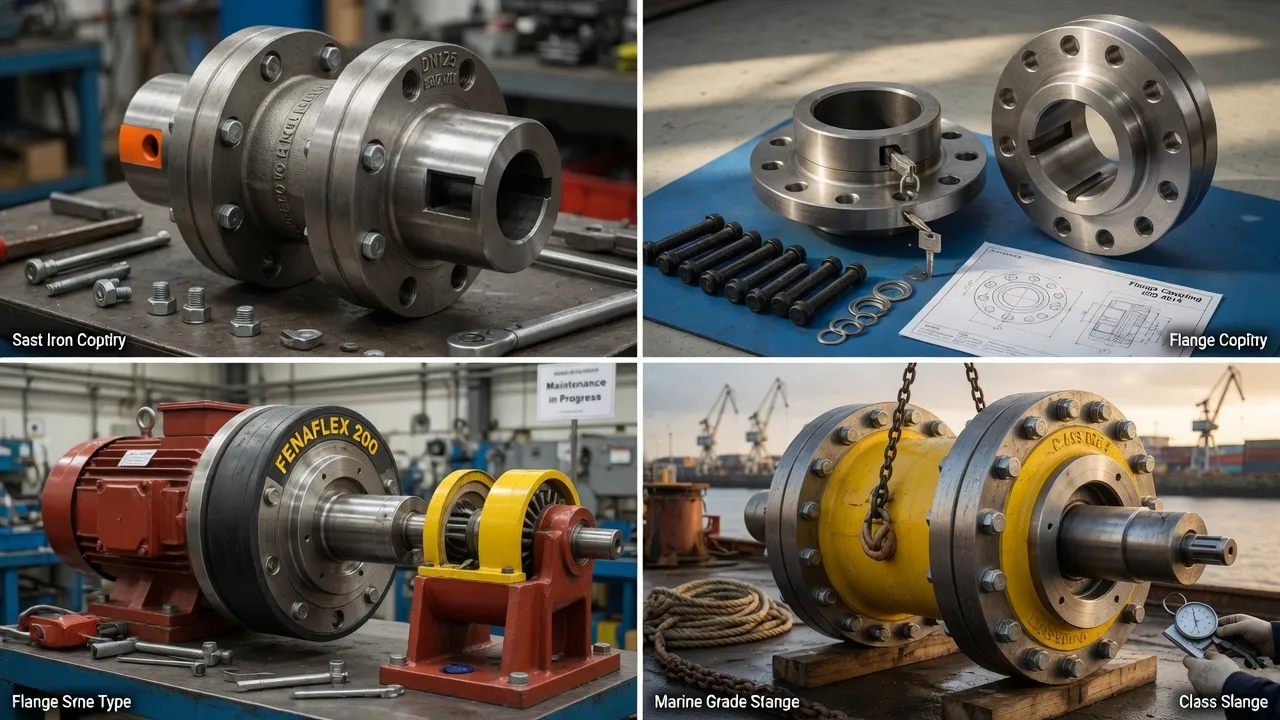
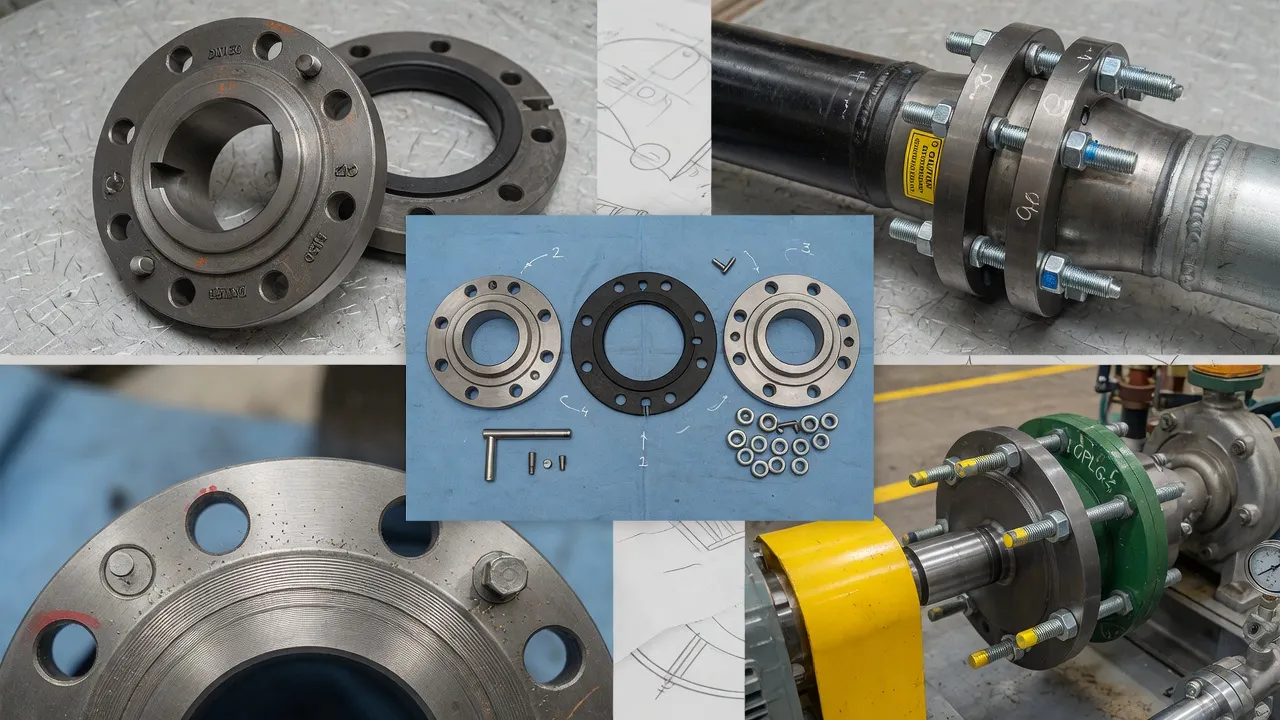
An overheating coupling is one of the clearest signals that something has gone wrong in the drivetrain — and one of the most frequently ignored. In many plants, coupling heat is accepted as normal, attributed to “just the way the machine runs,” and left unaddressed until the elastomeric element fails and forces an unplanned shutdown. The reality is that coupling overheating always has a specific, identifiable cause, and every cause has a specific corrective action that resolves the problem rather than managing the symptom. This guide maps the causes of coupling overheating, explains the diagnostic approach for each, and outlines the correct engineering response — including when the right answer is replacing the existing flexible tyre coupling with an upgraded specification and when a rigid coupling replacement is warranted.
The Four Causes of Coupling Overheating
1 — Shaft Misalignment (Most Common)
Misalignment forces the elastomeric element to deform cyclically on every revolution. The hysteretic energy loss in the elastomeric material generates heat at a rate proportional to the square of the misalignment angle and the running speed. On a pump running at 1,450 RPM with 0.5 mm parallel misalignment, the element completes 24 deformation cycles per second — each cycle dissipating energy as heat. This is the cause in the majority of coupling overheating cases, and correction is straightforward: laser alignment to within the coupling’s specification.
2 — Torque Overload (Coupling Under-Rated)
When the actual operating torque — including start-up peaks and shock loads — exceeds the coupling’s rated capacity, the elastomeric element deforms beyond its linear response range and enters a region of rapid hysteretic heating. The element temperature rises faster than heat can be dissipated through the coupling guard, producing progressive thermal degradation. The fix is to select a coupling rated for the actual design torque, calculated as nominal torque × service factor.
3 — Torsional Resonance
At certain operating speeds, the excitation frequency from the motor, pump, or VSD coincides with the coupling system’s torsional natural frequency. At resonance, the vibratory torque amplitude is amplified by the system’s Q-factor (typically 3–10×), producing cyclic torque loading far above the average. The resulting rapid hysteretic heating can raise element temperature by 30–50°C above ambient in minutes. The diagnostic signature is overheating at a specific speed, often clearing when speed is changed slightly.
4 — Incorrect Elastomer Grade for Operating Temperature
A standard polyurethane spider operating in a high-ambient-temperature environment (engine rooms above 40°C, outdoor equipment in Australian summer conditions, processes with radiant heat from furnaces or ovens) can exceed its continuous temperature rating even when alignment and torque loading are correct. The fix is to specify a higher-temperature elastomeric material — EPDM for moderate temperature elevation, or Hytrel for sustained high-ambient applications.
Diagnostic Sequence: Identifying the Cause of Your Coupling’s Overheating
1
Measure and Trend the TemperatureUsing an infrared thermometer, measure the coupling guard surface temperature at steady-state operating condition. Record it alongside the ambient temperature and the time since start-up. Repeat this reading at the same point for several consecutive days to establish whether the temperature is stable, rising, or only elevated at specific operating conditions.
2
Check Alignment First — It Is the Most Likely CauseWith the machine isolated, perform a laser shaft alignment check. Any misalignment above 0.1 mm parallel or 0.1° angular on a flexible coupling, or above 0.05 mm / 0.05° on a rigid coupling, is sufficient to produce meaningful overheating at typical industrial running speeds. Correct misalignment and re-check the temperature at the next opportunity. If overheating resolves, alignment was the cause.
3
Verify the Torque RatingCalculate the design torque: T = 9,550 × kW ÷ RPM × service factor. Confirm the coupling’s rated torque exceeds this value. If the coupling has been in service for several years and the motor or driven machine has been upgraded since installation, the coupling may now be under-rated for the current duty.
4
Check for Speed-Dependent Temperature PatternIf overheating only occurs at a specific speed setting on a VSD, torsional resonance is the probable cause. Try operating at ±5% of the suspect speed and observe whether the temperature and vibration change. If confirmed resonant, adjust the coupling’s torsional stiffness by changing the elastomeric element grade, or set a VSD skip frequency to avoid the resonant speed range.
Operating Temperature Limits by Elastomeric Material
Elastomeric Material
Continuous Temp. Limit
Peak Temp. Limit
Chemical Resistance
Best Application
Polyurethane (PU) 92A
80°C
100°C
Moderate — avoid ketones, esters
General industrial pump/fan drives
Natural Rubber (NR)
70°C
90°C
Poor — degrades in oil/ozone
High damping, low temp environments
Neoprene (CR)
90°C
110°C
Good — oil resistant
Engine rooms, oil-contaminated environments
EPDM
120°C
140°C
Excellent — chemical/UV resistant
Outdoor, high-ambient, chemical plants
Hytrel (Thermoplastic)
120°C
150°C
Very good
High-temp, aggressive environments
Frequently Asked Questions
What temperature is too hot for a flexible coupling?+
For standard polyurethane elastomeric elements (the most common type), the continuous operating temperature limit is 80°C for 92A grade and 70°C for 80A grade. A coupling housing you cannot hold your hand on comfortably for more than 2–3 seconds is above 60°C and warrants investigation. For natural rubber elements, the limit is 70°C. Temperatures above these limits accelerate material fatigue and thermal hardening that can halve the element’s remaining service life with each 10°C above the rated maximum.
Can I use an infrared thermometer to check if a coupling is overheating?+
Yes. An infrared thermometer pointed at the coupling guard surface gives a good indication of the elastomeric element temperature inside. Guard surface temperature will be 5–15°C lower than the element temperature due to the thermal resistance of the guard material. Take readings at the same location at the same time after commissioning to build a temperature baseline — a trend of rising guard temperature between quarterly readings indicates a developing overload or misalignment condition.
Does misalignment cause a coupling to overheat?+
Yes. Misalignment forces the elastomeric element to deform cyclically with every revolution. This hysteretic deformation generates heat within the elastomeric material — the same mechanism that warms a rubber band when flexed rapidly. The greater the misalignment, the greater the deformation amplitude, and the more heat generated per revolution. A coupling with significant misalignment can generate enough internal heat to exceed the elastomer’s rated temperature even at modest running loads.
Why does a coupling overheat under light load but not under full load?+
This is the signature of torsional resonance. At a specific speed, the excitation frequency from the drive system coincides with the coupling’s torsional natural frequency, producing resonant amplification of torsional vibration. The vibratory torque amplitude at resonance can be many times the average torque, causing the elastomeric element to undergo rapid cyclic deformation and heat generation. This resonance condition may occur at a part-load speed setting on a VSD drive, or at start-up speed before the drive ramps to full speed.
Can overheating permanently damage a coupling hub?+
Overheating damages the elastomeric element directly — hardening, cracking, and reducing torque capacity. Sustained overheating above 120°C can also cause deformation of the hub if the hub is aluminium (which softens above 150°C) and can cause fretting of the hub bore if differential thermal expansion increases micro-slip at the bore-to-shaft interface. Cast iron and steel hubs are not thermally damaged at coupling operating temperatures, but the adjacent shaft and bearing seals can be affected if coupling heat is conducted along the shaft.
Need Expert Coupling Advice?
Our engineering team in Condell Park NSW is ready to help — free of charge.