A flange coupling is not supposed to be a consumable. A correctly selected and properly installed coupling should run for years — often the entire service life of the connected machine — without significant attention. When a coupling fails in months rather than years, it is telling you something specific about the installation or operating conditions. Ignoring that message and simply fitting a replacement condemns the replacement to the same fate.
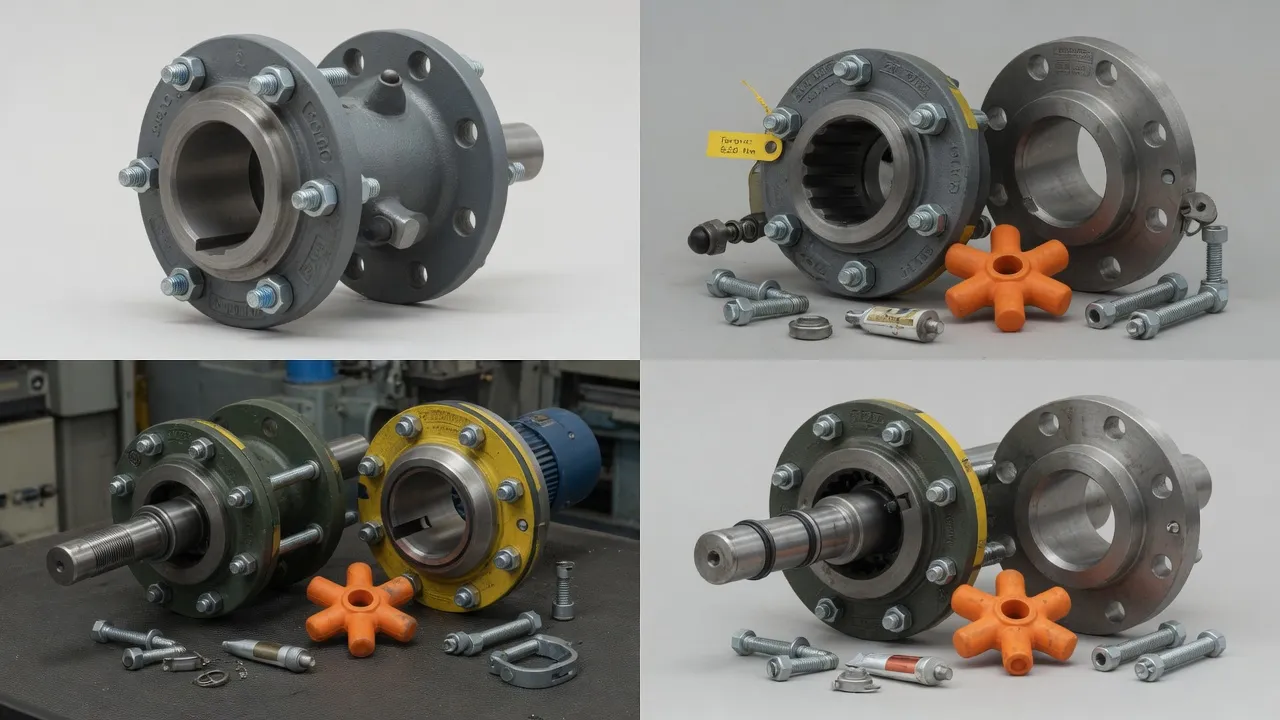
Misalignment: The Root Cause Behind More Than Half of All Coupling Failures
Shaft misalignment is the single most prevalent cause of premature flange coupling failure — and the most preventable. When the motor and driven machine shafts are not co-linear, the coupling must continuously deform and recover through every rotation to bridge the gap. In a flexible coupling, this cyclic deformation fatigues the elastomeric element far faster than rated service life under aligned conditions.
The insidious aspect of misalignment-induced failure is that it often develops gradually after commissioning. A coupling aligned correctly at installation may develop significant misalignment within 6–12 months as the baseplate settles, hold-down bolts relax, or thermal growth shifts shaft positions. By the time visible coupling wear appears, bearing damage is typically already in progress.
Under-Specification: When the Coupling Was Never Right for the Job
Coupling selection by bore diameter alone — fitting whatever coupling accepts the shaft without checking the torque rating — is a surprisingly common error in maintenance replacement scenarios. Key specification parameters frequently overlooked include the service factor (typically 1.5–2.5 for pump drives), the peak torque during DOL motor starting (which can reach 2–3× running torque), and the torsional stiffness requirement where a variable speed drive is involved.
Installation Damage That Produces Failures Months Later
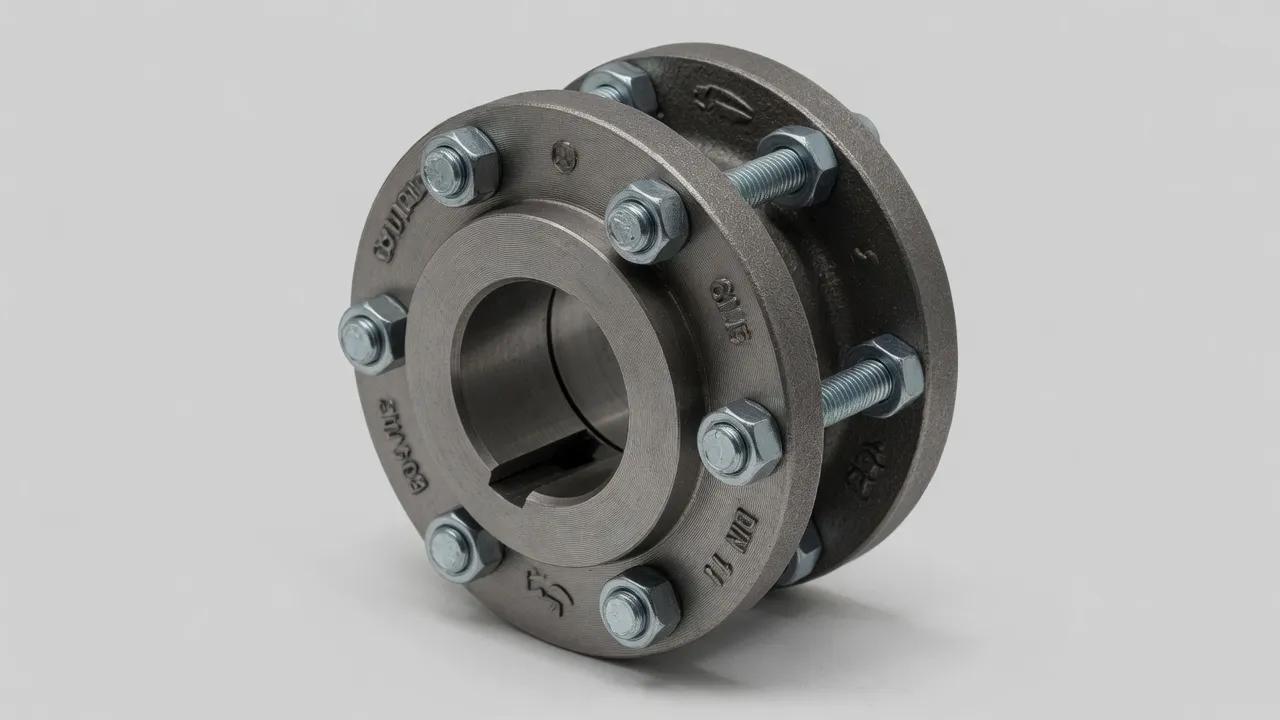
Hammering the hub onto the shaft creates shock loads that initiate micro-cracks in the hub bore — particularly in cast iron hubs. These cracks propagate under running loads and produce hub fracture failure, sometimes violently, at a time entirely unrelated to any change in operating conditions.
Incorrect key fit — a key that is too tight in the hub keyway — pre-stresses the hub bore and creates a hoop stress concentration at the keyway root. Combined with cyclic torque during operation, this promotes keyway cracking — the most common form of rigid flange coupling hub failure in high-torque applications.
Skipping soft-foot correction locks misalignment into the installation by the clamping force of the hold-down bolts. The laser alignment readings taken after tightening look acceptable — but the shaft position shifts under load, revealing misalignment that continuously loads the coupling.
Environmental Factors That Accelerate Coupling Wear
| Factor | Effect on Coupling | Mitigation |
|---|---|---|
| UV exposure (outdoor) | Hardens and cracks elastomeric elements within 6–12 months | Fit UV-resistant guard; specify EPDM tyre element |
| Oil or solvent contamination | Swells and softens natural rubber, reducing torque capacity | Specify neoprene (CR) or polyurethane for oil-present environments |
| High ambient temperature (>40°C) | Accelerates elastomeric fatigue; reduces rated torque by up to 20% | Apply temperature de-rating factor; consider metallic disc coupling |
| Abrasive dust ingress | Embeds in elastomeric surface, acting as cutting medium | Maintain coupling guard integrity; inspect element annually |
| Chemical splash | Degrades elastomers not rated for the specific chemical | Identify chemical type; specify correct elastomer grade |
Overload Events and Their Damage Patterns
A single severe overload — a pump jam, a crusher blockage, or a direct-on-line start against a locked rotor — can transmit peak torque several times the coupling’s rated capacity in milliseconds. A coupling element showing uniform wear across all lobes failed from sustained misalignment or under-specification. An element with one or two lobes torn out, or a bolt sheared in a single plane, typically indicates a transient overload event. Finding the source of that overload before the replacement coupling is commissioned is essential.
Frequently Asked Questions
Need Expert Coupling Advice?
Our engineering team in Condell Park NSW is ready to help — free of charge.