Description
✦ ISO 9001 Certified
✦ Lubrication-Free Operation
✦ Type B / F / H Available
✦ Sydney Same-Day Dispatch
What Is an F-Type Flexible Flange Coupling?
The F-Type flexible flange coupling — commonly known as a tyre coupling or tire coupling — is a three-part elastomeric power transmission device consisting of two cast iron or steel flanged hubs and a flexible rubber tyre element that connects them. The tyre element is the functional heart of the design: manufactured from high-grade natural or synthetic rubber compounds, it simultaneously transmits torque, absorbs angular and radial shaft misalignment, dampens torsional vibration, and provides a degree of electrical isolation between the driver and driven machines. This combination of functions in a single compact assembly is what makes the F-Type one of the most widely specified flexible coupling types across Australian industry.
Ever Power Flange Couplings Australia Ltd. stocks the complete F-Type range — F40 through F250 — at our Condell Park, Sydney facility, in all three standard hub configurations: Type B (through-bore with keyway), Type F (flanged end), and Type H (hub with set-screw). Transmission torque coverage runs from 10 N·m at F40 through to 20,000 N·m at F250, accommodating everything from small pump and blower connections up to heavy conveyor and mixer drives. The working temperature range of −20°C to +80°C makes the standard tyre compound suitable for the full spectrum of Australian climate and indoor industrial environments.
Unlike rigid alternatives, the F-Type torsionally flexible coupling requires no precision laser alignment before installation — the tyre element’s inherent compliance absorbs small angular and parallel shaft offsets that would impose damaging bearing loads in a rigid assembly. Combined with its lubrication-free, maintenance-light operation, this makes the F-Type a practical low-TCO (total cost of ownership) solution for facilities where the alignment quality of installed drives varies, or where maintenance shutdown frequency must be minimised.
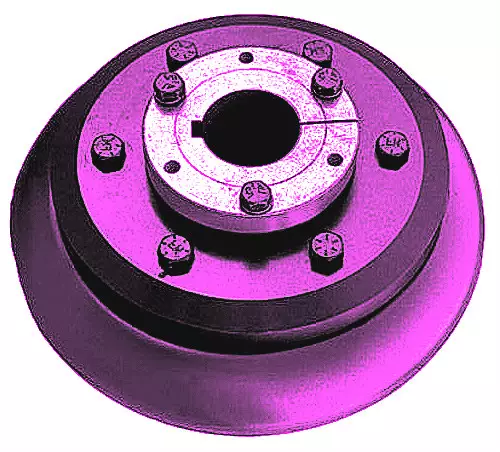
F-Type flexible flange coupling (tyre coupling) — stocked F40–F250, supplied by Ever Power Flange Couplings Australia Ltd., Condell Park NSW 2200
Construction Details & Hub Configuration Options
The F-Type coupling’s three-part construction is deceptively simple, but the interaction between hub geometry and tyre compound determines the coupling’s misalignment capacity, torque rating, and vibration characteristics. Understanding the hub configurations helps you specify the correct variant for your drive arrangement without unnecessary engineering uncertainty.
Tyre Element — The Performance Core
The tyre element is a toroidal rubber ring with integral steel wire reinforcement bead on each inner rim, which seats into machined grooves on the flanged hubs. In standard supply, the tyre is manufactured from GG-quality natural rubber with Shore A hardness in the 50–65 range — providing the balance between torque capacity and misalignment compliance that covers most pump, blower, compressor, and conveyor drive applications. Harder compounds (Shore A 70–80) are available for higher-torque or high-temperature applications; softer grades for enhanced vibration isolation in sensitive equipment connections. The tyre is field-replaceable without disturbing the hub mountings on the shafts — a significant maintenance advantage over coupling types where the flexible element is integral to the hub assembly.
Hub Types — B, F and H
Type B — Standard Through-Bore with Keyway
The most commonly stocked configuration. A cylindrical through-bore machined to H7 tolerance with a standard parallel keyway to h9. Both hubs in an assembly can be the same diameter or different diameters — a standard option for connecting a motor shaft of one size to a pump or gearbox shaft of another. This is the go-to choice for the vast majority of pump, fan, blower, and general industrial drive connections where ease of installation and field-replaceability of the tyre element are the primary considerations.
Type F — Flanged Hub
The Type F hub includes a bolt-on flange face for direct mounting to machinery with a flanged shaft end — such as hydraulic motors, fluid couplings, or flanged gearbox outputs. This configuration eliminates the need for a separate shaft connection and allows the coupling to be pre-assembled to the machine flange before being bolted to the tyre element. It is particularly common on pump sets where the motor drive end is flanged and the pump shaft is a standard through-bore arrangement.
Type H — Hub with Set-Screw
Identical to Type B in bore and keyway geometry, but with the addition of a radial set-screw that locks the hub axially on the shaft. This prevents creep under repeated start-stop loading without requiring a full interference-fit bore. Commonly specified for vertical-shaft pump drives, conveyor head shaft connections, and applications with frequent direction reversal where axial slip under cyclic loading is a risk with keyway-only retention.
Technical Specifications — F40 to F250 Size Range
The table below covers the standard F-Type flexible flange coupling size range available from Ever Power Australia’s Sydney warehouse. All sizes are available in Type B, F, and H hub configurations. Working temperature range: −20°C to +80°C (standard tyre compound). Transmission torque values shown are for the standard rubber compound; harder grades increase torque capacity by approximately 20–30% at a corresponding reduction in misalignment compliance.
| Size | Torque (N·m) | Max Speed (rpm) | Bore d (mm) | Outer Dia. D (mm) | Angular Misalign. | Radial Misalign. |
|---|---|---|---|---|---|---|
| F40 | 10 | 4800 | 12–20 | 40 | 3° | 0.8 mm |
| F60 | 40 | 4000 | 16–30 | 60 | 4° | 1.2 mm |
| F80 | 100 | 3600 | 20–38 | 80 | 4° | 1.6 mm |
| F100 | 200 | 3200 | 25–48 | 100 | 4° | 2.0 mm |
| F120 | 400 | 2800 | 32–56 | 120 | 5° | 2.4 mm |
| F140 | 800 | 2500 | 40–65 | 140 | 5° | 2.8 mm |
| F160 | 1600 | 2200 | 48–80 | 160 | 5° | 3.2 mm |
| F200 | 5000 | 1800 | 60–100 | 200 | 6° | 4.0 mm |
| F250 | 20,000 | 1400 | 80–130 | 250 | 6° | 5.0 mm |
Material: cast iron GG25 / GG20 (standard); carbon steel C45 (heavy duty). Axial misalignment: D×2%. Intermediate sizes F90, F110, F180, F220 also stocked — contact our Sydney team. Custom bore sizes and alternative tyre compounds available on request.
Key Performance Features of the F-Type Flexible Coupling
The F-Type tyre coupling earns its broad adoption across Australian pump, motor, and conveyor drive applications through a combination of practical engineering properties that directly reduce installation cost, operating risk, and maintenance burden. The following features are the primary reasons our Sydney customers specify this coupling ahead of jaw-type, disc-type, and gear coupling alternatives for general-purpose flexible drive applications.
Vibration Damping & Noise Reduction
The rubber tyre element’s inherent hysteresis absorbs torsional impulses before they propagate into the driven machine’s bearings, gearbox, or frame structure. For diesel pump sets, reciprocating compressors, and industrial fans operating near structural resonances, this damping effect directly extends bearing life and reduces the noise emission of the overall drive assembly — a meaningful benefit in confined plant rooms and near noise-sensitive areas.
Angular, Radial & Axial Misalignment Tolerance
The F-Type elastomeric coupling accommodates simultaneous angular misalignment up to 6° (size-dependent), radial offset up to 5 mm, and axial displacement equal to D×2% — making it far more tolerant of imperfect alignment than rigid or disc couplings. In practice this means a field mechanic can assemble the drive to normal standards and rely on the coupling to absorb thermal growth differentials, soft-foot effects, and minor positional variation without the coupling imposing load on bearings.
Lubrication-Free & Low Maintenance
There are no metal-to-metal contact surfaces in the power transmission path of an F-Type coupling — torque travels through the rubber tyre exclusively. This eliminates the need for grease nipples, oil intervals, and lubrication records. The only scheduled maintenance task is periodic visual inspection of the tyre for cracking, swelling, or hardening, and replacement when wear limits are reached — typically every 3–5 years under normal operating conditions.
Field-Replaceable Tyre — No Machine Movement
When the tyre element reaches end-of-life, it is replaced without removing either hub from its shaft — the tyre simply lifts out from between the two hub flanges once the clamping bolts are released. This dramatically reduces the time and cost of a routine tyre change compared to coupling types requiring shaft hub removal. On a typical pump set, a tyre replacement takes under 30 minutes by a single technician without any specialised tooling.
Electrical Isolation Between Driver & Driven
The non-conductive rubber tyre creates a natural electrical break between the motor shaft and the driven machine — preventing stray currents from passing through the coupling and damaging driven-end bearings via electrolytic corrosion. This property is particularly valued on VFD-driven pump sets and on generator set connections where shaft current suppression is a design requirement without the cost of a dedicated shaft earthing system.
Broad Operating Temperature Range
Standard tyre compound operates reliably from −20°C to +80°C — covering outdoor pump stations in inland NSW winter conditions through to hot process environments in manufacturing and mining plant. For applications above 80°C, a silicone or EPDM compound tyre is available from our custom range. Oil-resistant NBR compound tyres are available for environments where incidental petroleum product contact is anticipated.
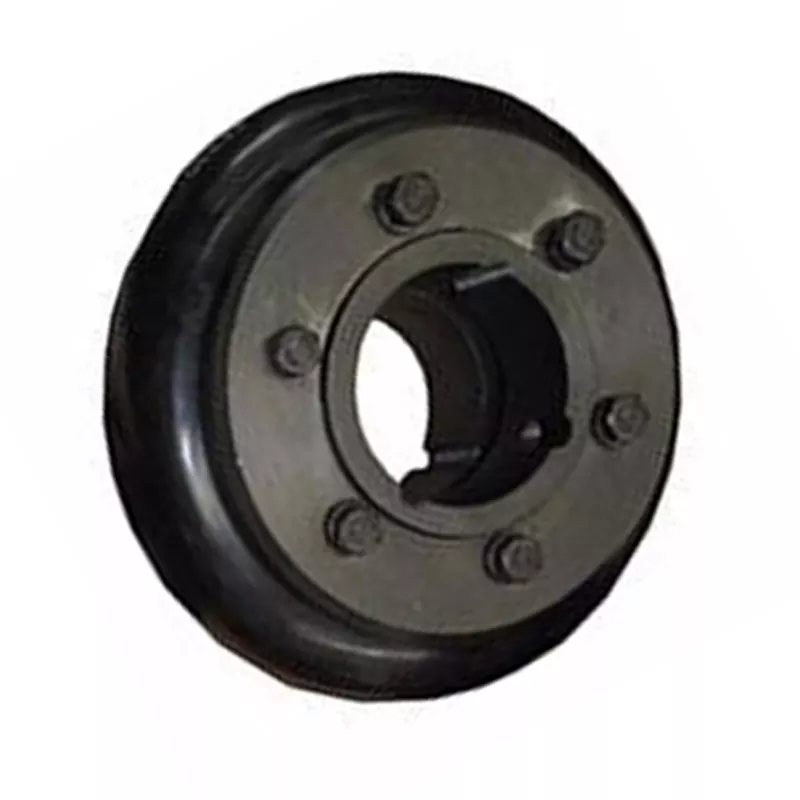
F-Type flexible flange coupling — hub and tyre element detail showing the three-part assembly configuration
Industrial Applications — Where the F-Type Excels
The F-Type flexible flange coupling is one of the most versatile drive connection devices in the industrial toolkit — equally at home connecting a fractional-kilowatt pump at F40 as it is handling a 200 kW primary conveyor drive at F250. The following applications represent the primary sectors in New South Wales and Australia where Ever Power supplies this coupling from our Sydney warehouse stock.
💧 Pump Drives — The Primary Application
The coupling for pump applications is where the F-Type has achieved its widest adoption across Australian industry. Centrifugal and submersible pump sets in water treatment, irrigation, mining dewatering, fire protection, and HVAC chilled-water systems are overwhelmingly connected using tyre-type flexible couplings. The combination of misalignment tolerance — which reduces installation alignment demands on pump sets that sit on baseplate-mounted structures prone to thermal growth and settling — and vibration damping that protects impeller shaft bearings makes the F-Type the de facto standard for pump motor coupling applications from F60 through F160.
⚙️ Motor Coupling for Industrial Drives
As a direct-drive motor coupling, the F-Type tyre coupling connects electric motors to driven machinery — fans, blowers, compressors, agitators, granulators, and material handling equipment — across the full power range. For VFD-driven motors, the tyre element’s torsional compliance helps absorb the torque ripple inherent in variable-frequency drive output waveforms, reducing the structural fatigue load on gearbox and driven machine bearings compared to rigid or disc coupling alternatives.
⚒ Mining, Quarrying & Bulk Handling
The product data sheet specifies wet, dusty, vibration-intensive, and complex working conditions as the primary environment for F-Type couplings — which is a near-perfect description of typical NSW open-cut mining and quarrying operations. Diesel pump sets used for dewatering, conveyor belt drive head pulleys, crusher auxiliary drives, and screen deck vibrator connections all benefit from the tyre coupling’s tolerance of contaminated environments, since the rubber element does not require dust exclusion seals or oil-tight housings to maintain its performance.
🏭 Food Processing & Packaging
Food-grade tyre compound options (FDA-compliant silicone or white natural rubber) make the F-Type suitable for direct and indirect food-contact drive applications in bakeries, dairy processing, beverage filling, and meat processing facilities. The lubrication-free operation is particularly valued here — grease contamination incidents from conventional gear couplings represent a serious food safety risk that tyre couplings eliminate by design.
🌊 Water Infrastructure & Utilities
NSW water utilities, wastewater treatment authorities, and stormwater pump stations operate thousands of pump sets on tyre-type flexible couplings due to their combination of alignment tolerance, electrical isolation, and long service life. For pump stations that run continuously and cannot be taken offline for frequent maintenance, the F-Type’s 3–5 year tyre replacement interval at minimal shutdown time represents a meaningful operational advantage over jaw couplings or HRC-type couplings with similar misalignment capacity.
🔋 Diesel Generator Sets
Direct-drive generator sets and pump-diesel units — common across remote NSW mine sites, agricultural irrigation systems, and emergency standby power installations — present one of the most demanding coupling environments: high starting torque transients, continuous torsional vibration from the engine firing pattern, and cyclic misalignment from engine thermal growth. The F-Type torsionally flexible coupling handles all three simultaneously, which is why it appears in both OEM diesel pump designs and as the preferred field-replacement coupling for worn or failed OEM disc-type couplings on generator sets.
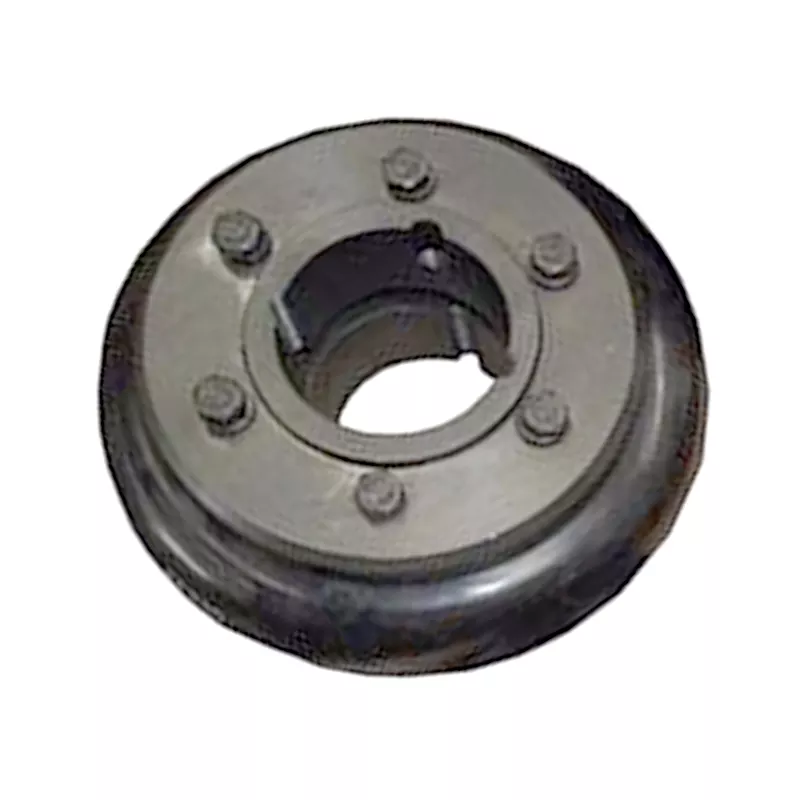
F-Type flexible flange coupling installed on a pump-motor drive assembly — lubrication-free, field-replaceable tyre element
Tyre Compound Selection — Matching Material to Environment
The performance of an elastomeric coupling is fundamentally determined by the rubber compound in its flexible element. Different compounds offer different balances between torque capacity, misalignment compliance, temperature range, and chemical resistance. The table below summarises the compounds available from Ever Power Australia, along with their primary application environments.
| Compound | Shore A | Temp. Range | Best For |
|---|---|---|---|
| Natural Rubber (NR) — Standard | 55–65 | −20°C to +80°C | General industrial, pumps, fans, blowers — stocked in all sizes |
| NBR (Nitrile Rubber) | 60–70 | −25°C to +100°C | Oil, grease & petroleum contact; mining, hydraulic environments |
| EPDM | 55–65 | −40°C to +120°C | Chemical plant, outdoor UV exposure, high-temperature environments |
| Silicone (FDA grade) | 50–60 | −55°C to +150°C | Food & beverage, pharmaceutical — FDA compliant, white/translucent |
Standard NR (natural rubber) tyre is stocked across the full F40–F250 range. NBR, EPDM, and silicone compounds are available on 5–10 working day lead time. Specify compound at time of order or contact our Sydney team for application-specific guidance.
Installation & Tyre Replacement — Step-by-Step
One of the strongest practical advantages of the F-Type flexible coupling is the simplicity of both initial installation and ongoing tyre element replacement. The five steps below cover both scenarios — a new installation and a routine tyre change on an existing assembly. Neither task requires specialised equipment beyond standard workshop hand tools.
Mount the Hubs onto Each Shaft
Clean shaft journals and coupling bores, verify bore diameter against H7 tolerance, and press or slide each hub onto its shaft. Insert the key and confirm it seats fully in both keyway slots. For Type H hubs, torque the set-screw to the specified value after positioning. Set the hub axial position to achieve the specified shaft-end to hub-face clearance dimension before tightening any retaining hardware.
Achieve Acceptable Shaft Alignment
Align the drive to within the coupling’s stated misalignment capacity — angular within 4°–6° and parallel offset within the D×1% radial deviation limit. While the F-Type tolerates far more misalignment than a rigid coupling, aligning as accurately as practical (targeting 0.1–0.2 mm parallel offset and 0.5° angular) maximises tyre service life by reducing the dynamic flexing amplitude of the rubber element during every shaft revolution.
Fit the Tyre Element
Position the tyre element between the two hub flanges, ensuring the bead on each end of the tyre seats properly into the machined groove on each hub flange face. No lubrication or adhesive is required or recommended on the bead seating surface. Fit the clamping bolts through the tyre bead flanges and hub flange holes finger-tight before applying any torque.
Torque the Clamping Bolts
Using a cross-pattern sequence, tighten the tyre clamping bolts to the torque value specified on the coupling drawing or in our Sydney-supplied data sheet for the relevant F-size. Over-tightening compresses the tyre bead and distorts the tyre profile — reducing compliance and introducing pre-stress into the rubber. Under-tightening allows the bead to walk out of its groove under dynamic loading. Correct torque is the single most critical installation variable for tyre coupling service life.
Commission and Inspect at First Service
Run up to full speed and observe for unusual vibration or tyre distortion (visible wobble during rotation). After the first 50–100 operating hours, inspect the tyre for any bead movement relative to the hub groove, re-check clamping bolt torque, and confirm tyre surface shows no cracking, swelling, or surface tackiness that would indicate chemical incompatibility. Schedule annual tyre visual inspections thereafter.
Why Source Your Flexible Coupling from Ever Power Australia
Tyre couplings are available from a number of Australian distributors and import channels. What differentiates Ever Power is our combination of local stock depth, technical knowledge specific to coupling selection and application, and the ability to supply non-standard tyre compounds and bore specifications without the minimum order quantities and extended lead times that larger importers impose. For maintenance engineers operating under production pressure, those differences matter.
F-Type Flexible Coupling Supplier — Sydney, New South Wales
Ever Power Flange Couplings Australia Ltd. is the Sydney-based specialist supplier for F-Type tyre flexible couplings and the full range of elastomeric and rigid shaft couplings across New South Wales and Australia. Our Condell Park warehouse serves maintenance departments, OEM machine builders, and engineering contractors across the Sydney metro area, Hunter Valley, Illawarra, and Central West NSW with same-day dispatch and next-business-day delivery on stocked items.
Australia Ltd.
Condell Park NSW 2200
New South Wales, Australia
Frequently Asked Questions
Practical answers from our Sydney coupling engineering team.
Request a Quote or Coupling Advice
Tell us your motor kW, shaft rpm, bore diameters, and environment — our Sydney team will confirm the right F-Type size, tyre compound, and a competitive price within one business day.
Ever Power Flange Couplings Australia Ltd. · 27 Harley Crescent, Condell Park NSW 2200 · [email protected] · flangecoupling.net