Description
The MH coupling is a two-flange flexible coupling that transmits torque through a synthetic rubber elastic ring captured between cast iron hub flanges. The synthetic rubber compound — chosen specifically for its operating temperature range, chemical compatibility, and damping characteristics — sets the MH apart from natural rubber couplings that degrade in oil, UV, and elevated temperature environments. The MHP super variant adds an internal steel core to the elastic ring, lifting the torque rating by 25 to 35 percent and extending the maximum operating speed for higher-duty applications.
MH Coupling Specifications
The MH range covers seven core sizes from MH 55 through MH 230, spanning the industrial drive torque envelope from 6.3 N·m at the smallest size up to 900 N·m at the largest. Each size is published in both the standard MH configuration (synthetic rubber ring without reinforcement) and the MHP super configuration (synthetic rubber ring with internal steel core reinforcement). The MHP variant carries approximately 25 to 35 percent higher torque rating than the standard MH variant of the same dimensional size.
| Model | Torque MH (N·m) | Torque MHP (N·m) | Max Speed (rpm) | Bore Range (mm) | Outer Diameter (mm) |
|---|---|---|---|---|---|
| MH 55 | 6.3 | 8.5 | 5000 | 10 – 18 | 55 |
| MH 65 | 12.5 | 17 | 4500 | 12 – 25 | 65 |
| MH 90 | 45 | 60 | 4000 | 18 – 38 | 90 |
| MH 115 | 112.5 | 150 | 3550 | 22 – 50 | 115 |
| MH 145 | 224 | 300 | 3150 | 30 – 60 | 145 |
| MH 175 | 450 | 600 | 2800 | 40 – 70 | 175 |
| MH 230 | 900 | 1200 | 2800 | 50 – 85 | 230 |
Operating temperature range across the entire MH range is -40 °C to +100 °C — significantly broader than natural rubber tyre couplings (typical limit +70 °C) and broader than the standard NBR rubber compound used in NM couplings. The synthetic rubber compound resists oil, dirt, grease, moisture, ozone, and many chemical solvents — making the MH the appropriate elastomeric coupling specification for chemical plant, petrochemical, food processing, and elevated-temperature manufacturing environments.
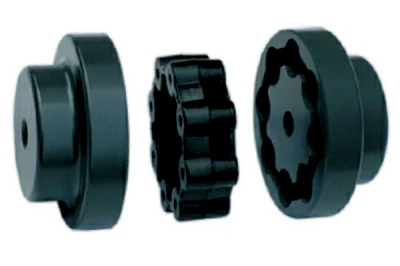
MH Coupling – two-flange flexible coupling with synthetic rubber elastic ring. MH 55 through MH 230. Ever Power Flange Couplings Australia Ltd.
How the MH Coupling Transmits Torque
Two cast iron hub flanges face each other across a small axial gap. Each flange carries an internal profile — typically a series of axial ribs or splined teeth — that engages with matching features on the synthetic rubber elastic ring positioned between the flanges. The ring is precision-moulded to fit the flange profiles with controlled clearance under no load. As torque is applied, the rubber ring deflects elastically, transmitting torque from the input flange through the ring to the output flange.
The rubber ring deflection is the misalignment compensation mechanism in addition to the torque transmission mechanism. Angular misalignment is accommodated by axial deflection of the ring at each engagement feature. Parallel offset is accommodated by radial deflection. Both modes operate within the elastic envelope of the synthetic rubber compound up to the rated misalignment values — typically 0.3° angular and 0.2 mm parallel offset across the MH range. The damping characteristic of the synthetic rubber compound also absorbs torsional vibration from the driver and reduces shock loading transmitted to the driven equipment.
Why Synthetic Rubber Versus Natural Rubber
Natural rubber compounds offer superior elastic response, low damping, and low cost — and serve well in clean, temperature-controlled environments. However, natural rubber degrades rapidly under oil exposure, UV radiation, ozone attack, and operating temperatures above 70 °C. Synthetic rubber compounds (typically based on chloroprene, EPDM, or specially formulated nitrile blends) trade slightly higher cost for dramatically improved environmental resistance — operating temperature to +100 °C continuous and +120 °C intermittent, full oil and chemical resistance, and stable mechanical properties through long service life in hostile environments.
Construction and the MH versus MHP Distinction
The flange hubs are machined from grey cast iron grade FC200 — chosen for the combination of vibration damping, manufacturing economy, and dimensional stability. Hub bores are finished to ISO H7 with standard parallel keyway as published in the dimensional documentation. Spline, hexagonal, round, set-screw, and keyway bore options are available at extra charge for specialised applications. Surface finish is standard industrial paint over phosphate conversion coating; zinc plating is available for outdoor and marine environments.
The defining construction difference between MH and MHP is the elastic ring. The standard MH ring is solid synthetic rubber moulded to the rated profile — pure elastomeric construction. The MHP super ring adds an internal steel core reinforcement that is co-moulded with the synthetic rubber during the ring manufacture. The steel core stiffens the ring against centrifugal expansion at high operating speed and against torque-induced extrusion at high transmitted torque. The result is the 25–35 percent torque rating uplift and the maximum operating speed uplift of the MHP variant compared to the standard MH.
Engineering Features of the MH Coupling
-40 °C to +100 °C continuous with the synthetic rubber compound — significantly broader than natural rubber tyre couplings. Stable mechanical properties across the temperature envelope. Suitable for applications including refrigerated processing, chemical plant, and elevated-temperature manufacturing.
Synthetic rubber compound resists oil, dirt, grease, moisture, ozone, and many chemical solvents. Performance retained in environments that cause natural rubber to degrade within months. Standard specification for chemical plant and food processing facility motor drives.
Synthetic rubber compound provides excellent internal damping — absorbs and suppresses torsional vibrations from driver and reduces shock loading on driven equipment. Critical for vehicle drivetrains, reciprocating compressor connections, and any application with significant cyclic torque variation.
MH: synthetic rubber ring without reinforcement, broadest misalignment compensation, highest damping. MHP: synthetic rubber with internal steel core reinforcement, 25–35% higher torque rating, higher maximum operating speed. Selection by application duty cycle.
Spline, hexagonal, round, set-screw, and keyway bore profiles available. Adapts to the wide range of shaft connection standards found across Japanese-origin, European-origin, and American-origin machinery installed in Australian industry.
Direct dimensional cross-reference to Mitsuboshi MH coupling and Tsubaki MH coupling sizes — widely referenced in Japanese-origin machine tools and process equipment. Provide OEM size code for confirmed equivalent specification from our Sydney engineering team.
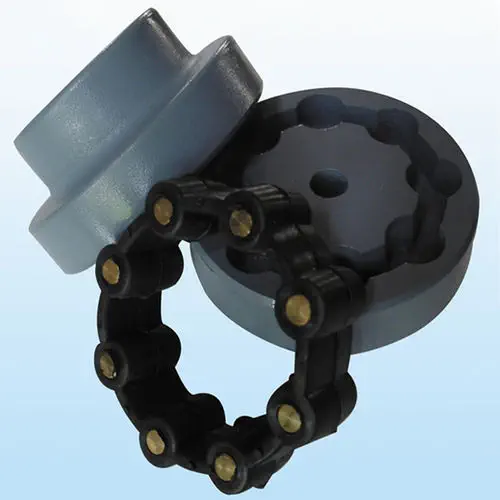
MH coupling construction – cast iron flange hubs with synthetic rubber elastic ring. MHP super type adds internal steel core reinforcement for higher torque and speed.
Application Field for the MH Coupling
The MH coupling appears across Australian industry wherever the application combines moderate misalignment compensation requirements with elevated operating temperature or hostile chemical environment. Pumps in chemical plant and petrochemical facilities — synthetic rubber resists the process spillage and elevated ambient temperature that would destroy natural rubber elements. Fans and compressors in elevated-temperature locations — refrigeration compressor rooms with 50 °C ambient, boiler-house ID and FD fan motors with similar elevated temperature.
Transportation, Mobile Equipment, and Specialised Applications
Vehicles and transportation equipment — the synthetic rubber compound tolerates engine bay temperatures and the cyclic torque pulsations of internal combustion engine drives. Construction equipment — cement mixers, road rollers, transmission machinery, and metalworking machinery use the MH for the combination of damping and chemical resistance. Tractors and agricultural equipment specify the MH where the application includes ground engagement contamination and elevated PTO temperature. Paper and pulp processing machinery uses the MH for the elevated ambient temperature and chemical exposure typical of pulping operations.
Selecting MH or MHP for the Application
The selection question between MH and MHP comes down to operating speed, transmitted torque, and the cost-versus-performance trade-off. The standard MH variant is the broader misalignment selection with higher internal damping — choose MH for general industrial duty within the published torque envelope. The MHP super variant carries 25–35 percent higher torque at the same dimensional size and supports higher maximum operating speed — choose MHP where the application is operating near the upper boundary of the MH torque or speed envelope.
Size selection within either variant follows the standard motor nameplate torque times service factor calculation. Pump and fan drives use service factor 1.25 to 1.5; conveyor and material handling drives use 1.5 to 2.0; engine-coupled and reciprocating drives use 2.0 to 3.0 because of the cyclic torque pulsations that benefit from the MH damping characteristic. The resulting design torque is matched against the published nominal torque to select the size. Confirm operating temperature is within the -40 °C to +100 °C envelope before final size confirmation.
Installation Workflow for the MH Coupling
MH installation follows the standard two-flange elastomeric coupling procedure — hub mounting, alignment, ring installation, and commissioning verification. The four-step workflow below applies to both MH and MHP variants. The synthetic rubber ring is a stocked spare item; periodic ring replacement during scheduled maintenance is a single-shift task without removing the cast iron hubs from the shafts.
Mount both cast iron flange hubs on their shafts with the flange faces toward each other. Confirm shaft engagement length and parallel key seating. Bring driver and driven equipment to rough alignment with straight edge before precision laser alignment.
Align angular and parallel offset to within half the rated envelope — typically 0.15° angular and 0.1 mm parallel offset. Lower alignment values extend ring service life significantly. Document final alignment values in the equipment maintenance record.
Position the synthetic rubber ring between the hub flanges, engaging the ring profile with the internal flange features. Confirm the ring is centred axially with no preload. Move both hubs axially toward each other until the ring is fully engaged on both flange profiles with the specified clearance.
Bump-start the drive to confirm correct rotation and engagement. Run for 30 minutes at progressive load monitoring noise and ring temperature. Normal ring temperature is ambient plus 10–20 °C in standard duty. Document the commissioning run in the equipment maintenance record.
Maintenance and Ring Replacement
The MH coupling is maintenance-free in normal industrial duty between scheduled ring replacement intervals. The synthetic rubber ring is the wear element; standard service life is 3 to 5 years in normal duty within rated torque and temperature envelope, extending to 5 to 7 years in lightly loaded applications with excellent alignment. Replacement is a single-shift maintenance task — separate the two flanges axially, remove the worn ring, install the fresh ring, and bring the flanges back together to the original installation position.
Ring wear indicators include audible knock from the coupling under torque reversal (replace immediately if intermittent, urgently if continuous), visible compression set or surface cracking on the ring during routine inspection, vibration signature change at constant load conditions, and excess running temperature compared to the historical baseline. Address any indicator promptly; running a worn ring beyond replacement point can damage the cast iron flange engagement features, requiring full coupling replacement instead of ring-only replacement.
Why Choose Ever Power Australia
Ever Power Flange Couplings Australia Ltd. carries the MH and MHP coupling range in Sydney warehouse stock — MH 55 through MH 230 with synthetic rubber and steel-reinforced ring variants available for same-day or 1-to-3 working day dispatch. Replacement rings, hub spares, and dimensional cross-reference to Mitsuboshi MH and Tsubaki MH series are supported directly from our Condell Park technical office. The ISO 9001 quality management system ensures consistent ring compound, hub dimensions, and bore tolerance across the entire MH range.

Ever Power manufacturing facility — ISO 9001 certified, 12,000 m², 108 dedicated coupling machines, 20+ years of production experience.
Every order placed with our Sydney team is backed by full material traceability, dimensional inspection certificates on request, and direct access to the engineers who specified, machined, and packed your coupling. We do not subcontract technical support — when you phone +61 2 9708 3322 during NSW business hours, you reach the people who actually know the product.
Frequently Asked Questions
Quick answers from our Sydney technical team. Contact us for application-specific guidance.
1. When should I specify MHP super variant rather than standard MH? +
2. What temperature range does the MH coupling support? +
3. Is the MH compatible with Mitsuboshi or Tsubaki MH coupling installations? +
4. Can the synthetic rubber ring be replaced without removing the hubs from the shafts? +
5. What is the difference between MH and NM couplings in selection? +
Request a Quote — Sydney NSW Stock
Tell us your motor power, shaft diameter, and operating environment. Our New South Wales coupling team confirms availability and pricing within one business day, with same-day dispatch on standard sizes from Condell Park.
Ever Power Flange Couplings Australia Ltd. · 27 Harley Crescent, Condell Park NSW 2200 · [email protected]